There’s nothing worse than reaching for your favorite quartz watch for a special occasion only to find the battery has died. Several watch types solve this problem entirely by running without a disposable battery, through mechanical winding, your own wrist motion, or light. This guide explains exactly how automatic, mechanical, kinetic and solar watches keep running without a battery change, so you can decide which type actually fits how you live.
Quick answer: automatic and mechanical watches run entirely without any battery, powered instead by a wound mainspring. Kinetic and solar watches, such as Citizen Eco-Drive, technically do have a battery, but it is rechargeable and almost never needs replacing, unlike the disposable battery in a standard quartz watch.
Written by Abdul Khader, watch enthusiast, researcher and writer at Topreviewd.
Key Takeaways
- Automatic and mechanical watches have no battery at all. Both run on a wound mainspring.
- Kinetic and solar watches have a rechargeable cell rather than no battery, which is a meaningful distinction most people miss.
- Most automatic watches hold a power reserve of 38 to 80 hours once fully wound, so wearing one daily keeps it running.
- Citizen’s Eco-Drive technology can charge enough for 24 hours of runtime from just 2 minutes of direct sunlight.
The Four Ways a Watch Runs Without a Disposable Battery
1. Automatic Watches
An Automatic Watch contains a weighted rotor that spins with the natural movement of your wrist, winding the mainspring as you go about your day. It is genuinely powered by almost every action you take, from typing to walking.
The trade-off is that it must be worn regularly to stay accurate, since the watch stops winding without movement. Collectors who rotate between several watches often use a watch winder to keep an automatic running even while it sits in a drawer.
2. Mechanical Watches
Mechanical watches use the same mainspring concept, but the wearer winds it by hand rather than relying on wrist motion. That stored energy powers the balance wheel, which oscillates several times per second and keeps time. Depending on the mainspring and movement design, a mechanical watch typically needs winding anywhere from daily to once a week.
3. Kinetic Watches
Kinetic watches are Seiko’s lineup of self-powered watches. For full transparency, a kinetic watch does have a battery, so it is not entirely batteryless in the strictest sense. It charges similarly to an automatic watch, except the rotor generates electrical energy rather than mechanical energy, which is then stored in a rechargeable cell.
Kinetic watches earn a place on this list because that battery is rechargeable and needs replacing far less often than the disposable battery in a conventional quartz watch, often lasting a decade or more before the cell itself needs service.
4. Eco-Drive and Other Solar Watches
Eco-Drive is Citizen’s solar watch lineup. Recharged by any light source, an Eco-Drive watch can run for about 24 hours from just 2 minutes of direct sunlight, and a full charge stores far more than that. Our comparison of Solar vs Automatic Watch covers how Eco-Drive stacks up against a traditional self-winding movement in detail.
Like the kinetic watch, an Eco-Drive has a battery, but it is built for recharging and reuse rather than disposal. One limitation worth knowing: an Eco-Drive can lose its charge if stored in a dark drawer for roughly six months, though this is quickly resolved by leaving it in sunlight again for a few hours.
Advantages of a Batteryless or Rechargeable Watch
- You never need to buy or replace a disposable watch battery.
- The watch does not stop unexpectedly the way a battery-powered quartz watch can when the cell dies mid-day.
- You avoid the environmental waste of disposing of single-use button cell batteries over the watch’s lifetime.
Which Type Should You Choose
- Choose automatic if you wear a watch daily and enjoy mechanical craftsmanship.
- Choose mechanical if you want the most traditional, hands-on experience and do not mind winding it by hand.
- Choose kinetic if you want quartz-level accuracy without the frequent battery changes.
- Choose solar or Eco-Drive if you want near-zero maintenance and do not want to rely on wearing the watch every single day.
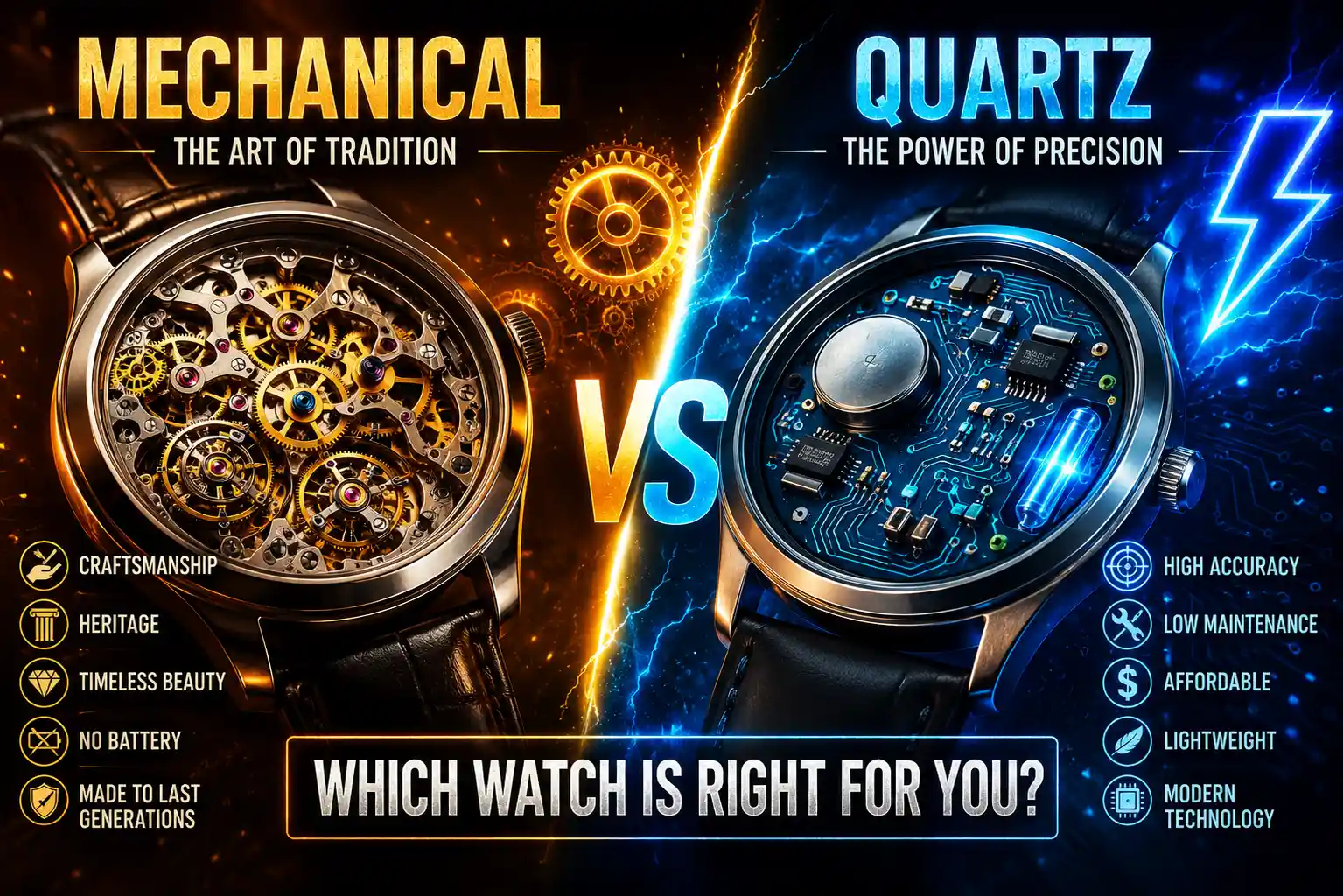
If you are still deciding between movement types more broadly, our guide to Different Types of Watches covers how these fit into the wider watch landscape, and our comparison of Mechanical vs Quartz Watch breaks down the accuracy and cost trade-offs in more depth.
Frequently Asked Questions About Watches That Work Without Batteries
Who makes watches without batteries
Seiko is the leading name in true battery-free and kinetic technology. Citizen also makes a battery-free automatic movement that it supplies to other brands, including Festina, and many established watchmakers produce automatic and mechanical models that need no battery at all.
Is a battery-free watch as accurate as a battery-powered one
Mechanical and automatic watches are generally less accurate than quartz, typically drifting a few to a few dozen seconds a day, because their oscillator is a balance wheel rather than a quartz crystal. Kinetic and solar quartz watches use the same quartz crystal oscillator as a standard quartz watch, so they match quartz accuracy closely.
Does Rolex need batteries
No, nearly all current Rolex models are automatic and use no battery, aside from the discontinued Oysterquartz line. A permanent internal rotor transfers energy from wrist motion to the mainspring to provide a stable power source.
Are Rolex watches self-winding
Yes, modern Rolex watches are automatic and designed to rewind through the wearer’s everyday natural movements. If the watch sits unworn for several days without a winder, it will eventually stop, and you can restart it by unscrewing the crown and winding it manually.
How do I know how much power reserve is left
Some watches include a power reserve indicator that shows how long the watch will continue running after you take it off, and the exact mechanism varies by brand. On Seiko Kinetic models, pressing a button moves the second hand in an arc, with a full 180-degree sweep for 30 seconds indicating a full charge, and a shorter arc indicating a partial one. Some models also use a faster, two-second oscillation of the second hand to warn that only a few hours of power remain.
Should I wear my automatic watch every day to keep it wound
Wearing it daily is the simplest way to keep the power reserve topped up, since ordinary wrist motion winds the rotor continuously. Most people find that wearing an automatic watch for 8 to 9 hours a day during normal activity is enough to prevent it from stopping overnight.
How long does an automatic watch’s power reserve last
The power reserve depends on the movement design and the mainspring used. Most automatic watches hold between 38 and 80 hours, while a handful of specialist movements extend to a week or more on a single full wind.
How does the mainspring actually power the watch
Winding the watch, either by hand or through the rotor, coils the mainspring tightly and stores potential energy in it, similar to compressing a spring. As the mainspring slowly unwinds, it drives the watch’s gear train, transferring that energy through the gears to the balance wheel and finally to the hands on the dial.
How This Guide Is Researched and Kept Current
I update this guide by checking manufacturer documentation and independent horology references against each other, since power reserve figures and charging times vary by movement and are often rounded inconsistently across different sources. Figures here reflect commonly cited ranges rather than one specific model’s exact spec, so check your own watch’s documentation for precise numbers. If you spot an error, please tell me through the Contact Us page and I will review it.
Final Thoughts
A battery-free watch is worth considering if you are tired of a quartz watch dying at the worst possible moment. Mechanical and automatic watches are powered entirely by winding or wrist motion. Kinetic and Eco-Drive watches use a rechargeable cell that avoids the frequent replacement a disposable quartz battery requires. Whichever you choose, you get a watch that is less likely to let you down right when you need it most.
About the Author
Abdul Khader is a watch enthusiast, researcher and writer, and the person behind Topreviewd. He writes about luxury and designer watches, automatic and quartz movements, materials, sizing, straps, crystals and water resistance, comparing watches across different price points so readers can judge what they get for the money.
His approach is practical. He checks specifications, points out when sources disagree, and keeps published details separate from his own opinion. Read more on the About Page, or reach him through the Contact Us page.
Related Articles: