A watch can keep time without a conventional disposable battery in several different ways. A traditional mechanical watch stores energy in a wound mainspring. A manual-winding model stores that energy when you turn the crown, while an automatic model uses a rotor moved by your wrist to wind the spring.
Solar and kinetic watches are different. They generate electricity from light or wrist movement and store it in a rechargeable power cell, so they avoid routine disposable-battery changes but are not strictly battery-free. Seiko’s Spring Drive is a special hybrid that uses a mainspring and electronic regulation without a battery or secondary cell.
This guide explains how each system works, what happens when its stored energy runs down, how accuracy and maintenance differ, and which type may suit your routine. It focuses on practical choices and manufacturer information rather than claiming every no-battery watch works the same way.
Written by Abdul Khader, researcher and writer at Top Reviewd. Last updated: November 4, 2026
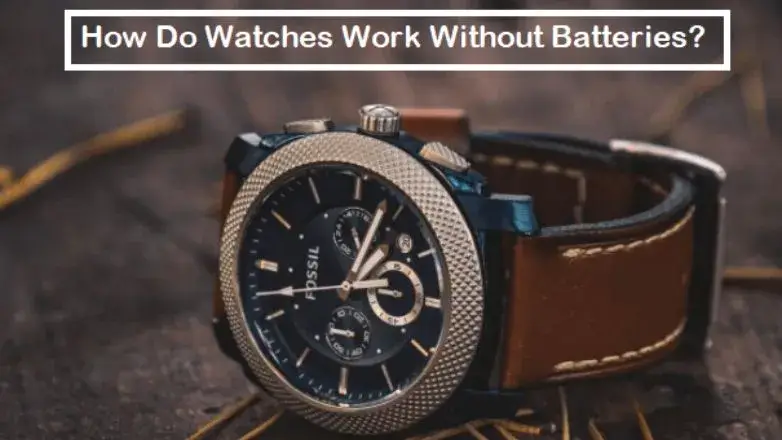
How Do Watches Work Without Batteries?
A genuinely battery-free watch uses stored mechanical energy instead of electricity from a cell. The energy is released in a controlled way so the hands move at the correct rate. In a typical mechanical movement, the mainspring supplies power, gears transmit it, and the escapement and balance regulate how that power is released.
The Main Parts Inside a Mechanical Watch
- Crown and winding system: The crown winds a manual movement and usually also sets the time. In an automatic watch, the rotor and winding train can wind the mainspring as the watch moves.
- Mainspring and barrel: The coiled spring stores mechanical energy. The barrel contains the spring and turns as the spring gradually unwinds.
- Gear train: A series of wheels and pinions transfers energy from the barrel to the hands and controls their relative speeds.
- Escapement: The escape wheel and pallet fork release energy in measured impulses instead of allowing the mainspring to unwind all at once.
- Balance wheel and hairspring: These components oscillate at a regular rate and act as the movement’s timekeeping regulator.
- Dial and hands: The motion is transmitted to the display so the watch indicates hours, minutes and seconds.
The Fondation de la Haute Horlogerie explains this same power path from winding mechanism to barrel, wheel train, escapement, regulator and display. See How a Mechanical Watch Works.
1. Manual-Winding Mechanical Watches
A manual-winding watch stores energy when you turn its crown. That action tightens the mainspring inside the barrel. As the spring unwinds, it drives the gear train and escapement, which move the hands at a controlled rate. The watch has no electrical battery and does not need wrist motion to keep its spring wound.
How often you need to wind it depends on the movement’s power reserve. Many owners wind a manual watch once a day, but the correct interval is the one stated by the manufacturer. Stop winding when the instructions indicate resistance or a full wind. Do not force the crown.
2. Automatic Mechanical Watches
An automatic watch is a type of mechanical watch. It uses a weighted rotor that swings as your wrist moves. The rotor transfers motion through a winding mechanism that tightens the mainspring. The spring then releases energy through the same basic gear train and regulating system found in a manual mechanical watch.
An automatic watch is not powered directly by each step you take. Your movement winds the spring, and the spring stores energy for later. When the watch is left off the wrist, it continues to run until its power reserve is used up. Some automatic movements can also be wound by hand through the crown, depending on the model.
For more detail, read our Mechanical vs Quartz Watch Guide and Automatic Watch vs Quartz Comparison.
3. Solar-Powered Quartz Watches
A solar-powered watch is usually a quartz watch with a solar cell beneath or around the dial. The cell converts light into electricity. A rechargeable power cell stores that energy and supplies it to the quartz circuit and timekeeping components when light is not available.
Citizen Eco-Drive is a well-known example. Citizen says its technology uses natural or artificial light and that a fully charged watch can run for more than six months in darkness, although the reserve varies by model. Eco-Drive avoids regular disposable-battery replacement, but it still contains a rechargeable power cell. See Citizen U.S. Eco-Drive Technology.
4. Seiko Kinetic Watches
A Seiko Kinetic watch uses wrist movement to turn an internal generator. The generator converts that motion into electricity, which is stored in a rechargeable battery and used to run a quartz movement. It combines an automatic-style energy generator with electronic quartz timekeeping.
Kinetic is not strictly battery-free. Its rechargeable cell may last much longer between replacements than a conventional disposable watch battery, but it can still age and eventually require service. Seiko explains the system in its U.S. Kinetic Watch FAQ.
5. Spring Drive: A Battery-Free Hybrid
Spring Drive is a specialized system developed by Seiko. A mainspring supplies the watch’s power, while a small generator driven by the movement produces electricity for a quartz oscillator and integrated circuit. The electronic system regulates the glide wheel electromagnetically. The movement does not use a conventional battery or secondary battery.
Spring Drive is neither a standard mechanical movement nor a conventional battery-powered quartz movement. It combines a mechanical power source with electronic regulation. Grand Seiko explains the system and its Tri-Synchro Regulator in its Spring Drive Movement Guide.
Battery-Free vs Rechargeable Watches: What Is the Difference?
The phrase “battery-free watch” is often used loosely. It can mean a watch with no electrical battery at all, or it can mean a watch that does not need frequent disposable-battery changes. Those are not the same thing. Use the table to identify what actually powers the watch.
| Watch Type | Where the Energy Comes From | Electrical Battery or Power Cell? | Truly Battery-Free? |
|---|---|---|---|
| Manual mechanical | The crown winds a mainspring | No | Yes |
| Automatic mechanical | A rotor moved by the wrist winds a mainspring | No | Yes |
| Spring Drive | A mainspring powers the movement and a generator for its electronic regulator | No secondary battery | Yes |
| Solar quartz / Eco-Drive | Light is converted into electricity and stored | Yes, a rechargeable power cell | No, but no routine disposable-cell replacement |
| Kinetic quartz | Wrist movement drives a generator that charges a cell | Yes, a rechargeable battery or cell | No, but no routine disposable-cell replacement |
| Standard quartz | A conventional cell powers the circuit and oscillator | Yes, usually a replaceable battery | No |
If your only requirement is a watch with no electrical battery, choose manual mechanical, automatic mechanical or Spring Drive. If your main goal is to avoid regular battery changes, solar and Kinetic watches may also suit you, provided you understand that their rechargeable energy-storage components can eventually need service.
Advantages and Limitations of Watches That Avoid Disposable Batteries
Potential Advantages
- A mechanical watch does not need disposable cells or periodic battery replacement.
- Automatic movements wind themselves while they receive enough wrist movement, which can be convenient for frequent wear.
- Solar and Kinetic systems can reduce routine disposable-battery changes by replenishing a rechargeable power cell.
- Mechanical watches offer a hands-on example of stored spring energy, gears and mechanical regulation.
Important Trade-Offs
- A mechanical watch still needs winding or sufficient wrist movement, and it stops when its power reserve runs out.
- Mechanical movements can be less accurate than quartz-regulated systems and generally need periodic servicing.
- Solar watches need suitable light exposure. A watch left in darkness for a long time may run down.
- Kinetic and solar power cells are rechargeable, not immortal. Age, condition and usage can affect their capacity.
- Rechargeable systems still contain electronic components and may need specialized service.
Accuracy, Power Reserve and Maintenance
There is no single accuracy figure or power-reserve duration that applies to every battery-free watch. Mechanical accuracy depends on the caliber, adjustment, condition, position, temperature and wear. Quartz-regulated solar and Kinetic watches generally offer quartz-style timekeeping, but their stated specifications are model-specific. Spring Drive uses a quartz oscillator to regulate a mainspring-powered system.
Power reserve means how long a fully wound or charged watch can continue running without receiving more energy. For a mechanical watch, check the manufacturer’s stated hours or days. For solar and Kinetic models, look for the full-charge runtime, low-charge warning and recommended charging or wear instructions. Do not assume all models share the same reserve.
Maintenance also differs. Mechanical watches need periodic professional service even though they do not need a battery. Solar and Kinetic watches may not need regular disposable-cell replacement, but their rechargeable cells and electronic parts can eventually require attention. Follow the manual for the exact reference.
Frequently Asked Questions About Watches Without Batteries
Can a watch really work without a battery?
Yes. Manual mechanical and automatic mechanical watches work without an electrical battery because a mainspring stores the energy that drives the movement. Spring Drive is another battery-free design that uses a mainspring with electronic regulation.
Are automatic watches completely battery-free?
A traditional automatic mechanical watch has no battery. Its rotor winds a mainspring as the wearer’s wrist moves. The mainspring then powers the gears and hands.
What is the difference between an automatic and a mechanical watch?
Automatic watches are mechanical watches. The difference is how the mainspring is wound. A manual mechanical watch is wound by turning its crown, while an automatic mechanical watch uses a rotor moved by the wrist. Some automatic models also allow manual winding.
Do solar watches have batteries?
Most solar watches contain a rechargeable power cell that stores energy gathered from light. They avoid frequent disposable-battery replacement, but they are not strictly battery-free. Citizen uses the term power cell for its Eco-Drive energy store.
Do Seiko Kinetic watches need battery replacement?
Seiko Kinetic watches store generated electricity in a rechargeable battery or cell. It generally needs replacement less frequently than a conventional quartz battery, but the rechargeable component can age and may eventually need service. Check the instructions for your model.
How long does an automatic watch run after you take it off?
It depends on the movement’s power reserve and how fully it was wound. The exact number of hours is model-specific. Check the manufacturer’s specification rather than assuming that all automatic watches run for the same length of time.
Do battery-free watches keep time as accurately as quartz watches?
Not necessarily. Traditional mechanical watches generally have more daily time variation than quartz watches. Solar and Kinetic watches use quartz timekeeping and generally follow quartz-style accuracy specifications. Spring Drive uses a quartz oscillator to regulate a mainspring-powered movement. Compare the published tolerance for each model.
Can an automatic watch stop if I do not wear it?
Yes. Once the mainspring’s stored energy is used up, the watch stops. You can wind it or follow the manufacturer’s wearing instructions to build up the power reserve again. A watch winder is optional and is not required for the movement to function.
Do mechanical watches need servicing even without batteries?
Yes. Lubricants age, parts experience wear and a movement can need cleaning, adjustment or repair. Follow the manufacturer’s service guidance and seek a qualified watchmaker if accuracy changes significantly, the watch stops repeatedly or it has been exposed to water or impact.
What is the best watch if I do not want to replace batteries?
A manual or automatic mechanical watch is the clearest choice if you want no electrical battery. A solar watch may be more convenient if you want quartz-style timekeeping and fewer battery changes. A Kinetic watch is another rechargeable option. The best choice depends on whether you prefer winding, wearing, exposing the watch to light or servicing an electronic power system.
Does Rolex make watches without batteries?
Most modern Rolex wristwatches use automatic mechanical movements and do not need batteries. Always check the exact model and reference if you are researching a vintage or unusual watch.
What happens when a mechanical watch runs out of power?
The mainspring unwinds until it no longer supplies enough energy, and the watch stops. Wind a manual watch or follow the winding and setting instructions for an automatic model. Do not shake or force a watch that appears damaged.
Final Answer: Which Watch Works Without a Battery?
Choose a manual or automatic mechanical watch, or a Spring Drive model, if you want a movement with no electrical battery. These watches store energy in a mainspring and release it gradually to keep time.
If your goal is to avoid regular disposable-battery changes rather than avoid every rechargeable cell, a solar watch or Seiko Kinetic may be more convenient. Solar models gather energy from light, while Kinetic models generate electricity from wrist motion. Both use rechargeable energy storage, which can eventually need service.
The right choice depends on how you wear and care for a watch. Compare the movement, power reserve, accuracy specification, charging needs and service requirements for the exact model before buying. For more watch guides, visit the Topreviewd Home Page.
Editorial Note
This article explains common ways wristwatches operate without conventional disposable batteries. It distinguishes fully battery-free mechanical and Spring Drive movements from solar and Kinetic systems that store generated electricity in rechargeable cells. It is an educational guide, not a hands-on test of every watch or movement. Runtime, accuracy, charging and maintenance vary by reference.
Trusted Sources
- Fondation de la Haute Horlogerie: How a Mechanical Watch Works, for mainsprings, gear trains, escapements and regulation.
- Seiko U.S. Kinetic Watch FAQ, for wrist-motion generation and rechargeable-cell storage.
- Citizen U.S. Eco-Drive Technology, for light conversion, power storage and model-dependent reserve.
- Grand Seiko Spring Drive Movement Guide, for the mainspring-powered generator and electronic regulation.
- Federation of the Swiss Watch Industry: Mechanical and Quartz Watches, for the differences between movement types.
How This Guide Is Researched and Kept Current
This guide was reviewed on November 4, 2026. The technical explanations were checked against educational material from the Fondation de la Haute Horlogerie, the Federation of the Swiss Watch Industry, and official Seiko, Citizen and Grand Seiko documentation. Brand-specific features and power reserves are described as model-dependent rather than universal.
This is not a laboratory test or a service manual. Always use the instruction booklet for your exact watch when winding, charging, setting or caring for it. If a model’s specifications are unclear, confirm them with the manufacturer or an authorized service provider. Readers can submit corrections through the Topreviewd Contact Us Page.
About the Author
Abdul Khader is a watch enthusiast, researcher and writer, and the person behind Topreviewd. He writes about luxury and designer watches, automatic and quartz movements, materials, sizing, straps, crystals and water resistance, comparing watches across different price points so readers can judge what they get for the money. His approach is practical. He checks specifications, points out when sources disagree, and keeps published details separate from his own opinion. Read more on the About Page, or reach him through the Contact Us Page.