You have probably noticed one on someone’s wrist. A watch with two small buttons beside the crown and a few mini dials that look borrowed from a cockpit. That is a chronograph. It looks busy, and it earns the look. This guide explains what a chronograph watch is, how its parts work together, and where the stopwatch function helps in real life. You will also get the history, a clear scale walkthrough, and practical buying advice.
This U.S.-focused guide explains the main chronograph layouts, how to start and reset the timer, what the bezel scales calculate, and which details matter when you compare watches. Some controls and counters vary by model, so the watch’s instruction manual remains the final reference for safe operation.
Written by Abdul Khader, researcher and writer at Top Reviewd. Last updated: November 5, 2026
What Is a Chronograph Watch?
A chronograph is a watch with a stopwatch built into the movement. According to Hamilton’s Chronograph Watch Guide, the mechanism measures elapsed time without interrupting the normal time display.
The key idea is “without interrupting.” Your watch keeps telling the time while the stopwatch runs on its own.
The name comes from two Greek words, chronos for time and graphein for to write. Worn & Wound traces that origin to the earliest versions, which literally marked a dial with ink.
Modern versions skip the ink. Thankfully, because nobody wants a stained shirt cuff.
A regular three-hand watch shows the time. A chronograph adds a second job: measuring elapsed time on demand while the watch continues its normal timekeeping. In everyday language, it is a watch with a built-in stopwatch. The stopwatch can be started, stopped, and returned to zero using the controls on the case.
| Feature | Regular Three-Hand Watch | Chronograph Watch |
|---|---|---|
| Time display | Hours, minutes, and running seconds | Hours and minutes, with running seconds arranged differently by model |
| Elapsed-time function | Usually none | Built-in stopwatch function |
| Controls | Usually a crown | Usually a crown plus one or more pushers |
| Extra dial features | Often a simpler dial | May include chronograph registers and a tachymeter or other scale |
The Parts That Make a Chronograph Look Different
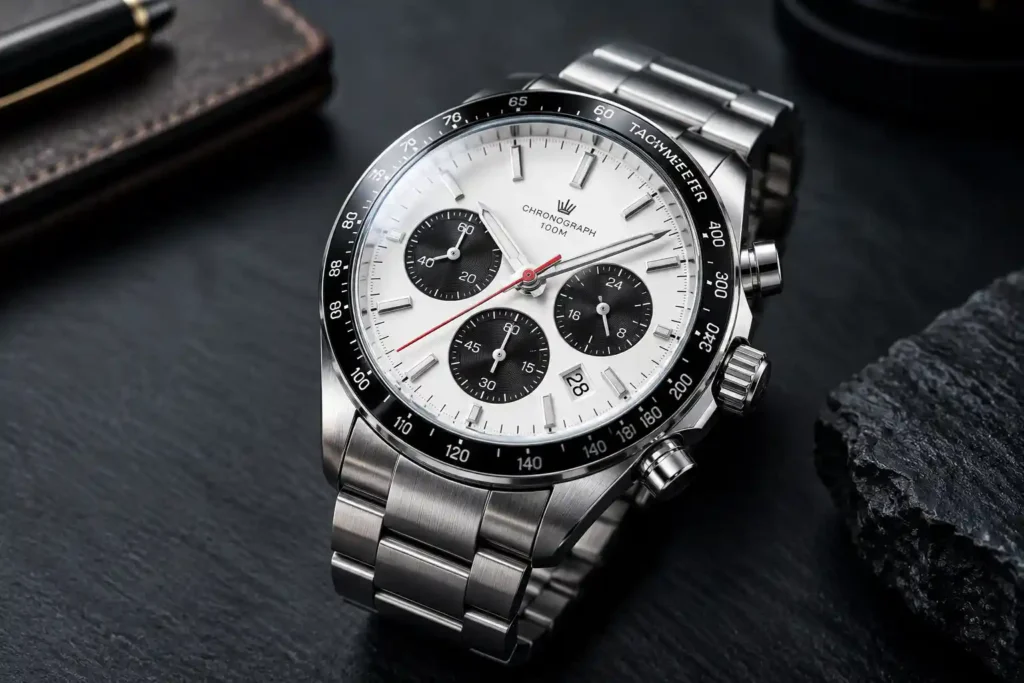
A chronograph has a few features that a basic watch lacks. Once you know them, the dial stops looking like a puzzle.
The Pushers
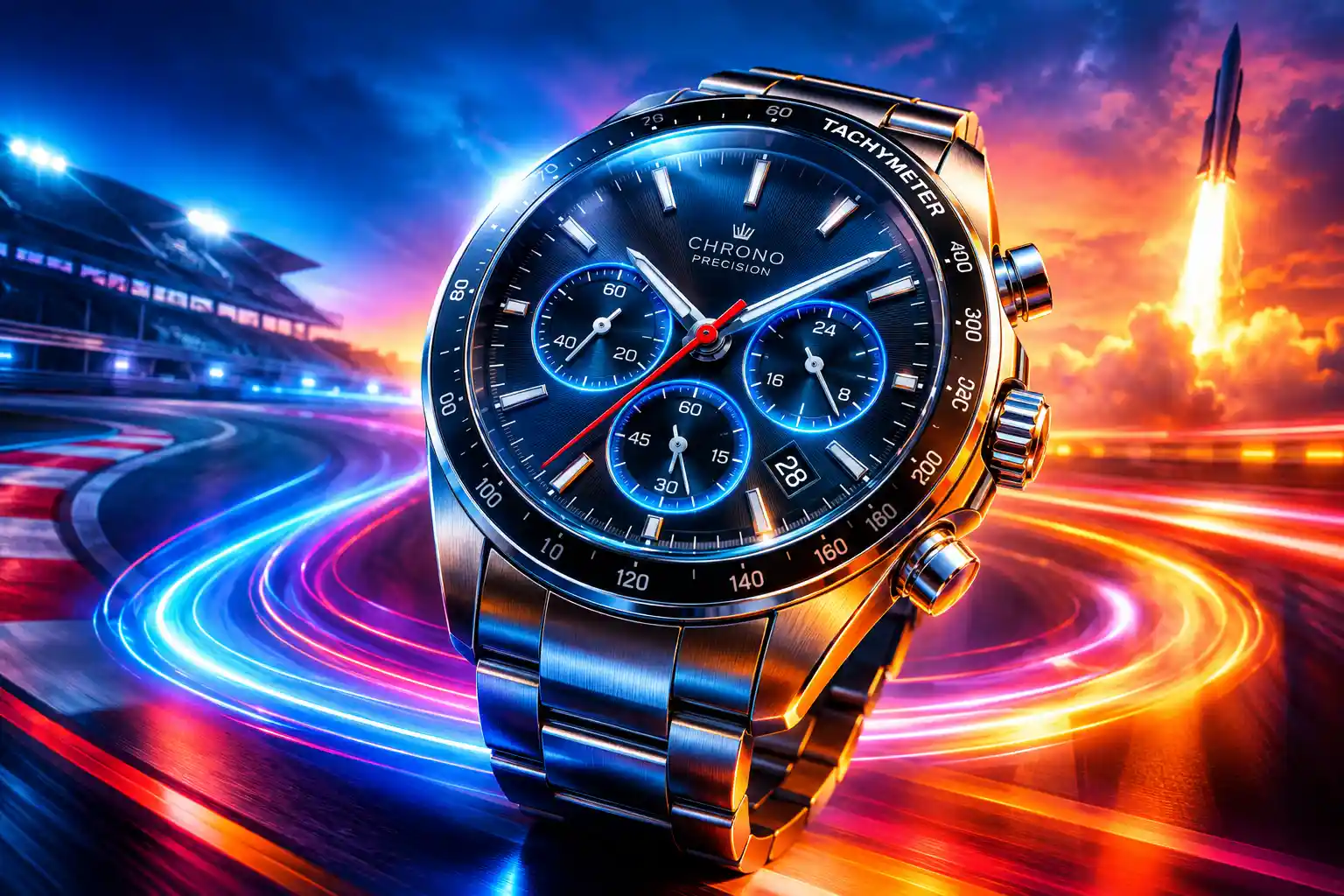
Many chronographs have two pushers, one above the crown and one below. On a common layout, the pusher near 2 o’clock starts and stops the stopwatch, while the pusher near 4 o’clock resets it. Hamilton describes this standard arrangement, but exact control layouts can vary, especially on monopusher and split-seconds models.
Hourstriker describes the standard layout in more detail. The pusher at 2 o’clock starts and stops the timing, and the one at 4 o’clock resets it.
Some watches use a single pusher for all three jobs. Collectors call that design a monopusher.
The Central Chronograph Seconds Hand
This hand sweeps around the dial while the stopwatch runs. On many chronographs it stays parked at 12 o’clock when the stopwatch is not active, while ordinary running seconds are shown on a small register. Some models arrange the hands differently, so check the dial labels and manual.
Think of it as a second opinion that only speaks when you ask.
The Sub-Dials
The small dials track longer spans. Depending on the layout, they count elapsed minutes and sometimes hours.
Some also show running seconds or the date. Layouts vary by brand, so read the markings on your own dial before you press anything. A common three-register layout has a small running-seconds display plus elapsed-minute and elapsed-hour counters. Other chronographs use two registers or arrange the counters differently. Do not assume every small dial measures stopwatch time.
The Tachymeter and Other Scales
Many chronographs print a scale on the bezel or the edge of the dial. That scale turns the stopwatch reading into something useful, like speed.
We cover the scales in their own sections below.
How Does a Chronograph Work?
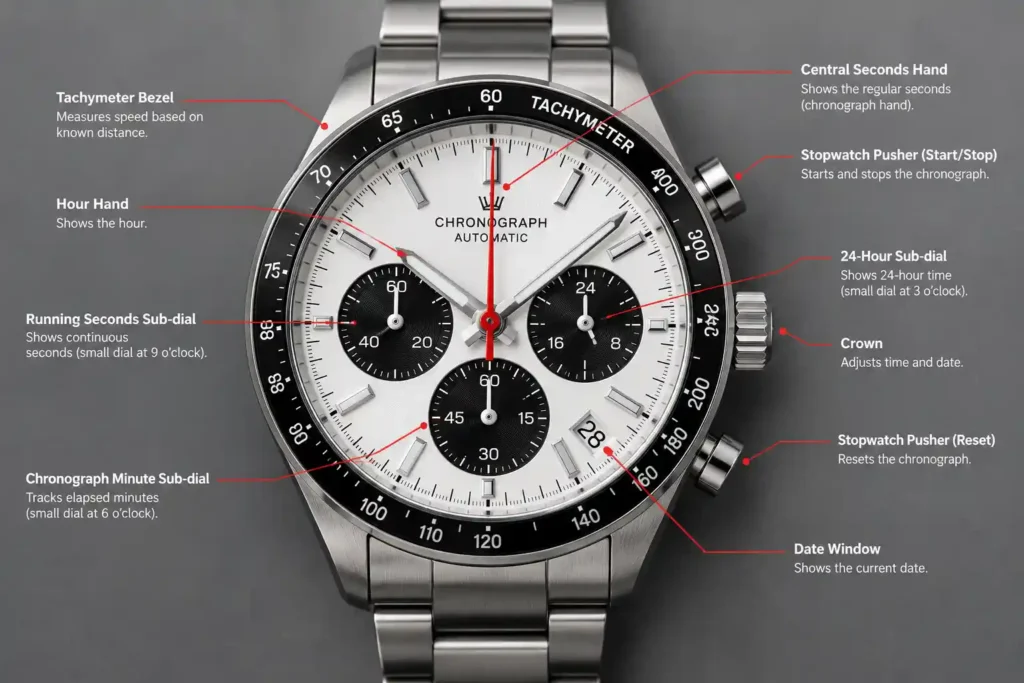
Inside, a chronograph adds extra levers and wheels to the normal timekeeping train. A clutch connects the stopwatch to the movement when you press start and disconnects it when you press stop.
Hourstriker explains that the first press couples the chronograph mechanism to the going train. The second press releases it so you can read the result.
Barrington Watch Winders describes the stopwatch gears as running independently of the main ones. That separation is why timing an event does not disturb the time of day.
Using one takes three simple steps:
- Press the top pusher to start timing.
- Press it again to stop and read the result.
- Press the lower pusher to reset the hands to zero.
On a standard design, the reset pusher stays blocked while the chronograph runs. You must stop it first, which protects the mechanism from careless pressing.
Mechanical Versus Quartz
Chronographs come in mechanical and quartz versions. A quartz chronograph runs on a battery and electronics, while a mechanical one runs on springs and gears.
Quartz models are usually simpler to maintain and often offer convenient timing functions. Mechanical models appeal to people who enjoy the movement and its construction. For a closer look at the trade-offs, read our guide to Mechanical vs Quartz Watches.
Modular Versus Integrated Movements
Some automatic chronographs stack a chronograph module on a base movement. Others build the complication into the movement from the start.
Neither architecture is automatically better. An integrated design can be compact and purpose-built, while a modular construction can allow a chronograph module to be paired with an established base movement. Service complexity, parts availability, thickness, and repair cost depend on the specific calibre and its maker, not on the label alone.
Column Wheel Versus Cam: What Controls the Pushers
Mechanical chronographs use one of two systems to control start, stop and reset. They are the column wheel and the cam.
A column wheel looks like a tiny castle turret. Rotate Watches notes that brands such as Zenith and Rolex use it in well-known calibers.
A cam system replaces that turret with a shaped part that moves the levers. Hourstriker names the Valjoux 7750 as the famous example.
Worldtempus reports that the column wheel costs more to make and gives a smoother pusher feel. The cam is robust, cheaper and suited to high-volume production.
Does that make the cam worse? Not necessarily. Deployant points out that a cam chronograph runs essentially the same, because precision depends on the balance rather than the switching method.
So treat the column wheel as a potential advantage in control feel, not a guarantee of accuracy. If you can, press the pushers in a shop before you decide.
Column Wheel or Cam Versus Vertical or Horizontal Clutch
These terms describe two different parts of the chronograph. A column wheel or cam controls the sequence of start, stop, and reset actions. A clutch connects or disconnects the stopwatch mechanism from the watch’s timekeeping train. A mechanical chronograph may therefore be described by both its control system and its clutch system.
A horizontal clutch brings two wheels into engagement side by side. A vertical clutch couples components stacked on the same axis. Seiko’s Museum of Ginza explains both designs and how the clutch transfers power to the chronograph. The type can influence the movement’s construction and operating characteristics, but it does not by itself tell you how accurate or reliable the complete watch will be.
For technical background, see The Seiko Museum’s Explanation of Mechanical Chronograph Mechanisms.
What Is a Flyback Chronograph?
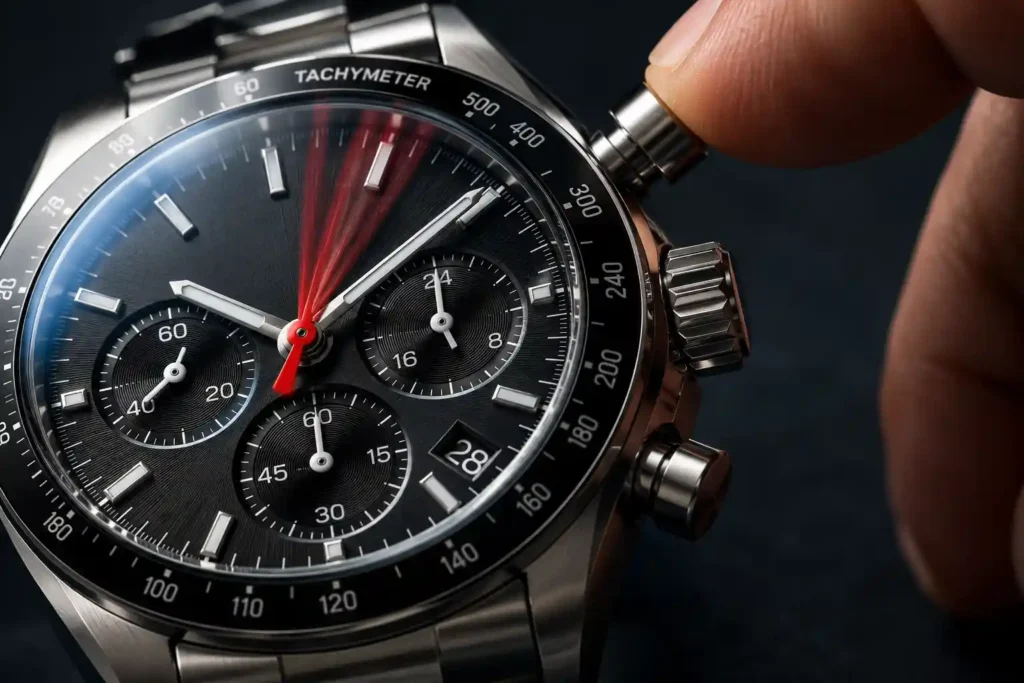
On a standard chronograph, timing a second event takes three presses: stop, reset, and start. A flyback chronograph shortens that to one.
Hourstriker explains that you press the reset pusher while the chronograph is still running. The hands snap to zero and start again instantly.
That helps with repeated laps or back-to-back intervals. Longines says it secured patent protection for its pioneering flyback chronograph on June 16, 1936. The important milestone is the patented flyback mechanism, which let pilots time successive stages with fewer steps.
What Is a Split-Seconds Chronograph?
A split-seconds chronograph, also called a rattrapante, has two chronograph seconds hands that normally move together. A separate pusher can stop one hand to record an intermediate time while the other continues timing. Pressing the split control again lets the stopped hand catch up with the moving hand.
This is useful when two competitors start together but finish at different moments, or when you want to record a lap split without stopping the main timer. The extra mechanism is substantially more complex than a standard chronograph. See TAG Heuer’s Explanation of the Split-Seconds Chronograph and IWC’s Guide to the Rattrapante Function.
Chronograph Watch History: Key Milestones
The chronograph has a better backstory than most gadgets.
Louis Moinet and the 1816 Breakthrough
Historians now credit French watchmaker Louis Moinet with the earliest known chronograph, completed in 1816 to time astronomical observations. The Federation of the Swiss Watch Industry describes his compteur de tierces as a high-frequency timer with start, stop, and reset controls. It beat at 216,000 vibrations per hour, an extraordinary rate for the period. Read the industry history from the Federation of the Swiss Watch Industry.
His piece resurfaced in 2013. Before that, most sources gave the credit to someone else.
Nicolas Rieussec and the Horse Races
Nicolas Mathieu Rieussec presented a timing device at a horse race in 1821 and patented his ink-marking chronograph in 1822. It recorded elapsed time by placing ink marks on rotating dials. The rediscovery of Moinet’s earlier instrument means Rieussec is better described as a key pioneer of the commercially developed ink chronograph, rather than the inventor of the first chronograph.
Rieussec delivered a device that marked a rotating dial with ink. The Greek roots of the word fit that design perfectly.
Wrist Chronographs and Separate Pushers
Teddy Baldassarre’s history says Longines produced a wrist chronograph in 1913 with accuracy to one fifth of a second. Gaston Breitling later introduced a separate reset pusher.
Sources disagree on the year, with some citing 1915 and others 1923. That is common in watch history, where brands love a good origin story.
The 1969 Race
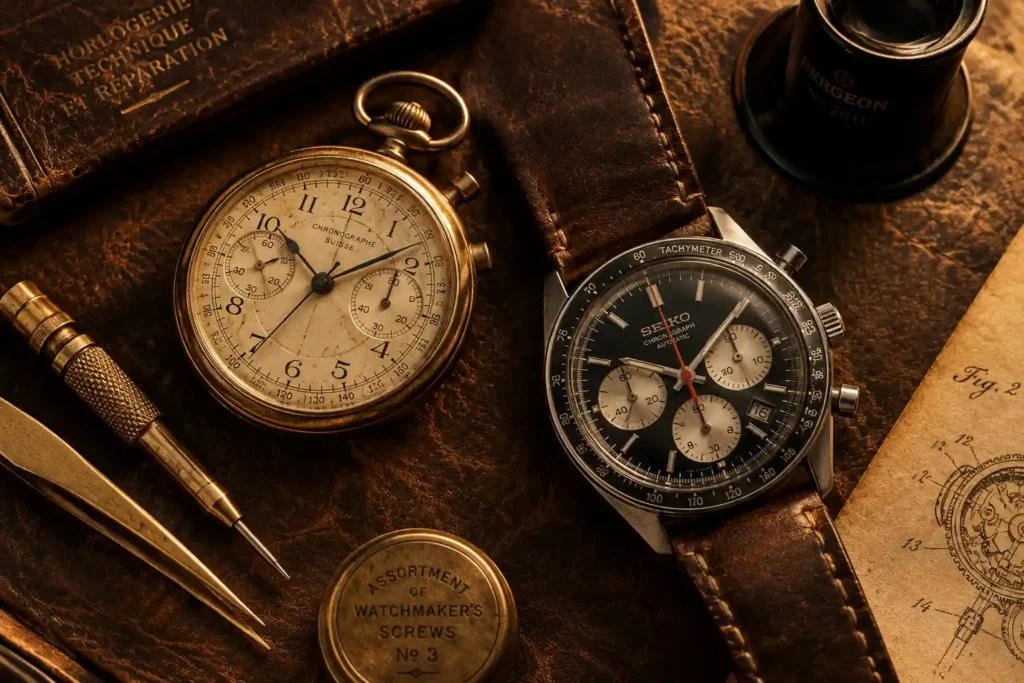
Then came 1969, when several watchmaking teams brought automatic chronographs to the market in a remarkably short period. Zenith publicly announced the El Primero on January 10, 1969. Its high-frequency integrated movement beat at 36,000 vibrations per hour and could measure tenths of a second.
Heuer, Breitling, and Hamilton presented their jointly developed Chronomatic watches at press conferences on March 3, 1969, and retail examples were available later that year. Seiko introduced its 6139 automatic chronograph in Japan in 1969. Seiko describes the 6139 as the first automatic chronograph with both a column wheel and vertical clutch. These are related but distinct milestones, so no single short “first” claim captures the whole story.
The best way to understand the race is to separate the public announcement, the technical design, and when buyers could actually purchase a watch. Zenith’s El Primero Timeline, TAG Heuer’s 1969 History, Seiko’s Heritage Archive, and Hodinkee’s Chronomatic History document different parts of this closely contested year.
What Is a Chronograph Watch Used for?
This is the question most readers care about. Does a stopwatch on your wrist matter when your phone has one?
Sometimes it does. Here are the practical uses.
Timing Everyday Tasks
You can time a boiling egg, a parking meter, a workout interval or a presentation. The watch already sits on your wrist, so there is no unlocking or app hunting.
It also stays silent. No alarm sounds, which your colleagues will appreciate.
Rating Repeated Tasks
A tachymeter can rate repeated events, not only speed. Time one full cycle of a task, then read the hourly rate from the scale.
One watch guide suggests production line cycles or even a barista pulling an espresso. It is a quirky use, but it works.
Sport and Lap Timing
Runners, swimmers and cyclists time intervals with a chronograph. A flyback model suits repeated efforts because it resets and restarts in one press.
Aviation and Motorsport
Barrington Watch Winders says the chronograph built its reputation from the racetrack to the cockpit. Brands noticed and designed dials around those customers.
That heritage explains why so many chronographs carry motorsport or aviation styling.
Space Missions
Omega’s Speedmaster is the best-known example. Gear Patrol Reports that NASA flight-qualified the Speedmaster Professional in 1965.
The same article points out the irony of its tachymeter. The scale suits car speeds over one kilometer, which does little at orbital velocity.
Everyday Style
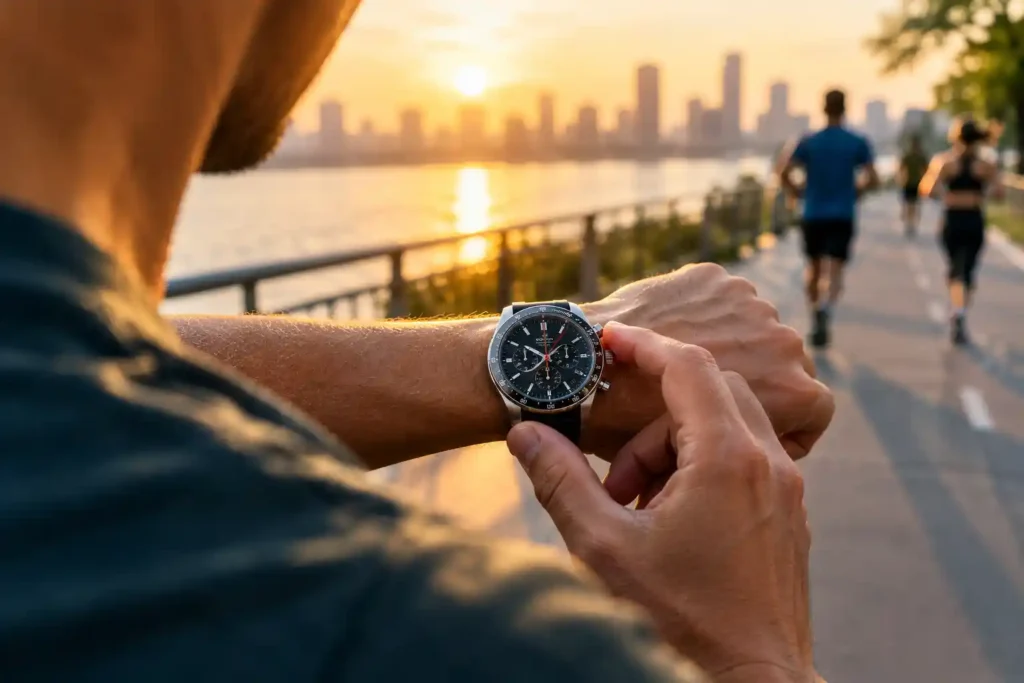
Many people buy a chronograph because it looks good. The sub-dials add depth, and the design works with a suit or a T-shirt.
That is a valid reason. Not every purchase needs a spreadsheet.
How to Read a Tachymeter Scale
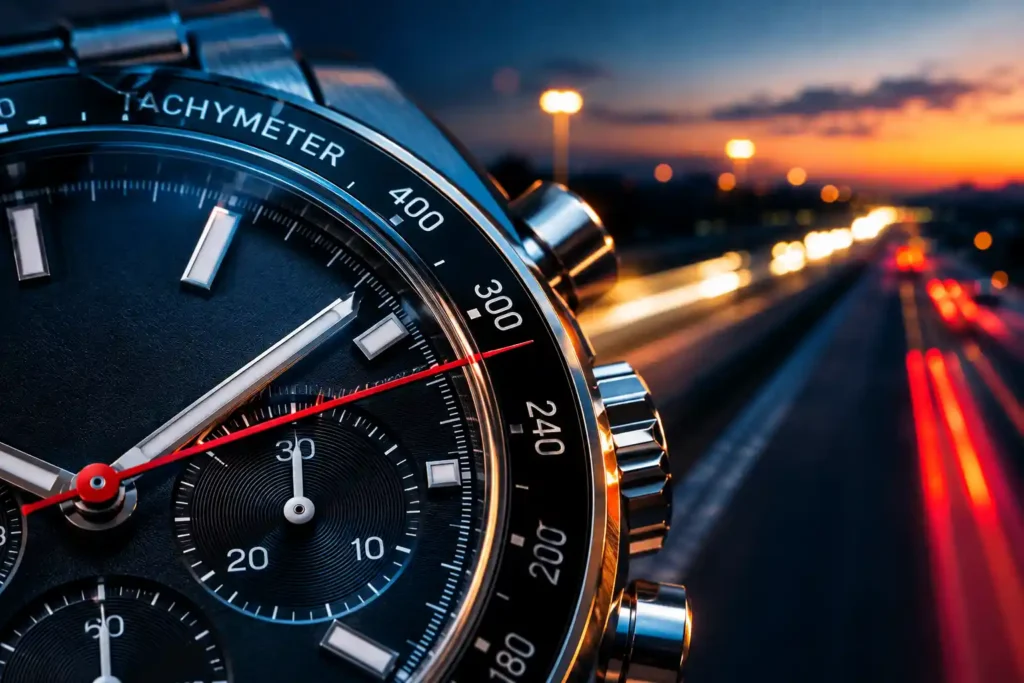
A tachymeter scale converts the time taken to cover a known distance into an approximate average speed. Start the chronograph at the beginning of a measured unit, then stop it exactly one kilometer or one mile later. The scale is calibrated to a unit distance, so use the matching unit on the display. Casio’s guide explains the one-kilometer method and the 30-second example.
The seconds hand then points to your average speed on the scale. For a one-unit distance, the calculation is 3,600 divided by the number of seconds. A 30-second time over one kilometer gives 120 km/h. The same 30-second time over one mile gives 120 mph.
A Tachymeter Measures Average Speed, Not Live Speed
The scale is useful only when the distance is known and measured accurately. It does not use GPS, measure instant speed, or compensate for an inaccurate start or finish point. Some tachymeter scales are designed around a 60-second timing range, so slower events may fall outside the marked scale. For the exact operating method, follow the watch manual or see Casio’s Tachymeter Instructions.
Two examples:
- 30 seconds over one kilometer reads 120 kilometers per hour.
- 45 seconds over one kilometer reads 80 kilometers per hour.
The distance must be exact. A late start or a wrong marker ruins the result.
The scale also has limits. A reading over one kilometer tops out at 60 seconds, so slower speeds fall off the scale.
Some tachymeter scales can also help estimate the time needed to cover a unit of distance at a known constant speed, but the watch manual should explain whether the printed scale is intended for that use. For most owners, the straightforward use is timing a known distance and reading average speed.
Telemeter and Pulsometer Scales
Some dials add two rarer scales. They look peculiar, yet each solves a simple problem.
The Telemeter
A telemeter estimates how far away an event is, using the gap between light and sound. Start the chronograph when you see lightning and stop it when you hear thunder.
The scale then shows the approximate distance. Montres Passion notes that makers base the scale on a speed of sound around 333 or 340 meters per second.
Do the quick math. Three seconds at 340 meters per second gives roughly one kilometer. This is an estimate because the speed of sound changes with air conditions, and reaction time affects the result. A telemeter is an interesting timing scale, not a substitute for weather alerts or a safety distance measurement.
The same source adds that artillerymen once used it to estimate the distance to enemy fire. Today, storm watching is the friendlier use.
The Pulsometer
A pulsometer measures heart rate, and doctors once relied on it. Cortina Watch calls it a doctor’s watch and says the scale usually counts 15 or 30 pulses.
You start the chronograph at a beat, count to the marked number and stop. The hand then shows an estimated beats-per-minute reading. Follow the dial’s printed count, since the scale may be calibrated for 15, 30 or another number of beats. A watch pulsometer is a mechanical estimating aid, not a medical monitor or diagnostic device. Do not use it to assess symptoms or make health decisions.
For a 30-pulse scale, the math is 1,800 divided by the seconds taken. If the hand stops at 30 seconds, the rate is 60 beats per minute.
Time and Tide notes that Omega’s Speedmaster Chronoscope carries tachymeter, telemeter and pulsometer scales together.
Chronograph Versus Chronometer
These two words look alike, and people mix them up constantly. They are not the same thing.
A chronograph measures elapsed time. A chronometer has passed an accuracy test.
The terms do not exclude each other. Teddy Baldassarre’s guide notes that a chronograph can also be a chronometer if it meets the standards.
What the Chronometer Test Involves
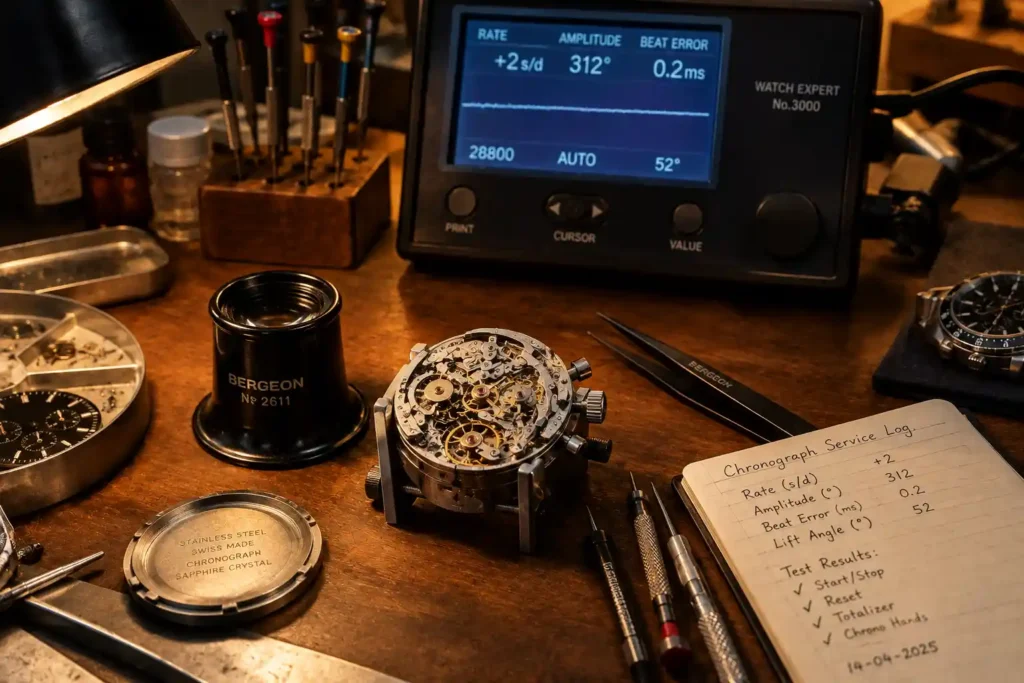
In Switzerland, mechanical chronometer certification is commonly associated with COSC. The certification process tests a movement over 15 days in different positions and temperatures against defined rate and variation criteria. Longines explains the distinction between a chronograph and a chronometer and notes that the standard mechanical chronometer test is based on ISO 3159.
A chronometer certificate concerns timekeeping performance under the specified test conditions. It does not mean the watch has a stopwatch function, and it does not guarantee that every cased watch will show precisely the same rate in every owner’s conditions. Check which organization certified the movement or finished watch and what the certificate covers.
Some brands run stricter tests of their own. WatchGecko reports that Rolex certifies its watches to minus 2 and plus 2 seconds per day.
Wikipedia also notes a debate among enthusiasts about how meaningful the COSC test is. Treat certification as one useful signal rather than the whole story.
Pros and Cons of Owning a Chronograph
Every complication has a trade-off. Here is the honest version.
The Good Parts
- You get a stopwatch without carrying anything extra.
- The dial looks more interesting than a standard layout.
- Many models carry real heritage and a clear purpose.
The Not-So-Good Parts
- The dial can look cluttered, which slows quick time reading.
- Mechanical chronographs usually cost more to service because the movement is more complex.
- Careless pusher use can wear parts over time.
None of these should scare you off. They simply set expectations.
How to Choose a Chronograph Watch
Start with what you will actually do with it. A casual wearer and a lap-timing enthusiast need different things.
Pick Your Movement
Choose quartz for convenience and lower upkeep. Choose mechanical or automatic if you value the mechanism itself. Our guide to Automatic Watches vs Quartz Watches explains the main differences.
Check the Dial Layout
Make sure the sub-dials read clearly at a glance. Contrast and spacing matter more than the brand name.
Test the Pushers
Press them in a shop if you can. A clean, confident feel suggests good adjustment, whether the watch uses a column wheel or a cam.
Decide on the Scale
A tachymeter is handy if you like the look or plan to use it. If you will never time a vehicle, a cleaner dial may suit you better.
Set a Realistic Budget
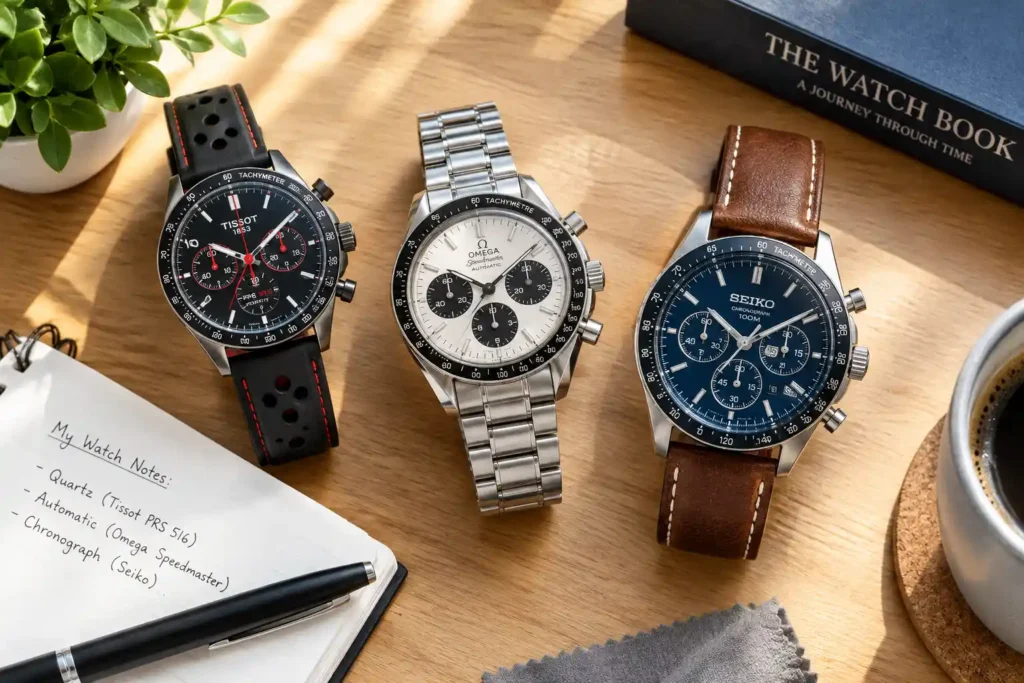
Chronographs range from affordable quartz models to high-end mechanical pieces. Set your range first, then compare movement, case size and service costs. Also check dial legibility, pusher position, counter range, water-resistance instructions, replacement strap availability, and the cost of battery changes or mechanical servicing. A large case and several sub-dials may look impressive but can be harder to read and wear.
If you want to see how a major brand presents its watches, read our Rolex Watch Review. It shows how a leading maker describes design and function. You can also explore more educational articles in the Topreviewd Watch Guides library.
Simple Care Tips
A chronograph does not need fussy treatment, but a few habits help.
- Stop the stopwatch before you reset it.
- Check your manual before pressing pushers near water, since water resistance varies by model.
- Follow the manufacturer’s service schedule.
- Replace the battery on schedule if your watch runs on quartz.
Some chronographs use screw-down pushers to help protect the case when the watch is exposed to water. If yours has them, follow the manual for when to unlock and relock the pushers. Never assume that a chronograph can be operated underwater. Unless the maker specifically permits it, do not press the pushers while the watch is submerged or wet.
Final Thoughts
A chronograph is a watch with a stopwatch that runs alongside normal timekeeping. Pushers control it, sub-dials track elapsed time, and optional scales can convert elapsed time into average speed, estimate distance, or calculate a pulse rate.
It began in the early 1800s as a tool for astronomers and race fans. Today, it works as a practical timer and a stylish piece of everyday gear.
Whether you time laps, boil eggs or just like the look, a chronograph earns its place on the wrist. Pick one that fits your habits, and it will keep doing its job quietly. Explore more watch education and comparisons on the Topreviewd Homepage.
Chronograph Watch FAQs
1. What is a chronograph watch in simple terms?
It is a watch with a built-in stopwatch. You time events with the pushers while the regular time keeps running.
2. What is a chronograph watch used for in daily life?
People use it to time tasks, workouts, meetings and cooking. It also helps with lap timing and repeated intervals.
3. Is a chronograph the same as a chronometer?
No. A chronograph measures elapsed time, while a chronometer has passed an accuracy test. One watch can be both.
4. Who invented the chronograph?
Louis Moinet completed the earliest known chronograph in 1816. Nicolas Rieussec presented an ink-marking timing device at a horse race in 1821 and patented it in 1822.
5. What does the tachymeter on a chronograph do?
It converts elapsed time over a known distance into average speed. You time one kilometer or mile, then read the scale.
6. What is a flyback chronograph?
It lets you reset and restart in a single press while the chronograph runs. That makes it handy for repeated timing.
7. Is a column wheel chronograph better than a cam one?
A column wheel is often associated with a more refined pusher action, but the feel depends on the full movement design and adjustment. Neither a column wheel nor a cam system guarantees better timekeeping accuracy.
8. Can I press the reset pusher while the chronograph runs?
On a standard design, no. Stop the chronograph first, then reset it.
9. Do I need a chronograph watch?
No, but you may enjoy one. If you like the look and the stopwatch function, it is a fun addition.
10. Are chronographs hard to use?
Not at all. On a common two-pusher model, start and stop use the upper pusher, and reset uses the lower pusher after the timer has stopped. The exact controls can vary by watch.
11. What Are the Small Sub-Dials on a Chronograph For?
They are registers that may show elapsed minutes, elapsed hours, or the watch’s ordinary running seconds. Their functions vary by movement and dial layout, so check the printed markings and instruction manual.
12. Can You Reset a Chronograph While It Is Running?
Many standard chronographs require you to stop the timer before resetting it. A flyback chronograph is designed to reset and restart while running. Follow the manual for your particular watch rather than forcing a pusher.
13. Can You Press Chronograph Pushers Underwater?
Do not press the pushers underwater unless the manufacturer specifically says the watch is designed for that operation. Water resistance differs by model, and operating a pusher can compromise seals on some watches. Check the watch manual before use near water.
14. Does a Chronograph Watch Need a Battery?
It depends on the movement. A quartz chronograph normally uses a battery, while a mechanical chronograph is powered by a mainspring and does not use a disposable battery for timekeeping. Some watches combine electronic and mechanical features, so check the model specification.
15. Does a Tachymeter Show Exact Speed?
No. A tachymeter estimates average speed over a known distance. The reading depends on accurate start and finish points and the scale being used with its intended distance unit. It does not measure live speed like a GPS device.
16. Is a Chronograph More Accurate Than a Regular Watch?
Not automatically. The chronograph is an elapsed-time complication, not an accuracy rating. Timekeeping accuracy depends on the movement, regulation, construction, condition, and testing or certification. A chronograph may also be certified as a chronometer, but the two terms describe different things.
17. Can You Leave a Chronograph Running All the Time?
It depends on the watch and its movement. Running the chronograph continuously may affect power consumption or power reserve on some models, and the manufacturer may give specific operating advice. Read the manual rather than assuming continuous operation is either harmful or harmless for every chronograph.
Editorial Note
This guide explains common chronograph designs and functions using published manufacturer documentation and watch-industry references. Pusher positions, counter layouts, scale calibration, water resistance, and operating instructions vary by model. It is an educational guide, not a substitute for the instruction manual for your watch. No claim is made that every watch described has been physically tested or disassembled.
Trusted Sources
- Hamilton Chronograph Watch Guide
- Casio Tachymeter Instructions
- The Seiko Museum: Mechanical Chronograph Mechanisms
- Federation of the Swiss Watch Industry: Louis Moinet and the Chronograph
- Longines Flyback Chronograph Patent History
- Zenith El Primero History
- TAG Heuer 1969 Automatic Chronograph History
- Hodinkee Chronomatic History
- Longines Explanation of Chronometer Certification
- TAG Heuer Split-Seconds Chronograph Guide
How This Guide Is Researched and Kept Current
This guide was reviewed on November 5, 2026 against current manufacturer explanations, watchmaking references, technical museum material, and historical records. Manufacturer and industry sources are prioritized for operating instructions, movement design, chronograph history, and certification. Where historians or brands describe competing 1969 milestones differently, the article explains the distinction rather than assigning an unqualified single winner.
We check model-specific instructions where a general explanation could be misleading, particularly for pusher layout, flyback operation, tachymeter calibration, and water resistance. Prices and product recommendations are not the focus of this educational guide. Readers can report a correction or ask a question through the Contact Us Page.
About the Author
Abdul Khader is a watch enthusiast, researcher and writer, and the person behind Topreviewd. He writes about luxury and designer watches, automatic and quartz movements, materials, sizing, straps, crystals and water resistance, comparing watches across different price points so readers can judge what they get for the money. His approach is practical. He checks specifications, points out when sources disagree, and keeps published details separate from his own opinion. Read more on the About Page, or reach him through the Contact Us Page.