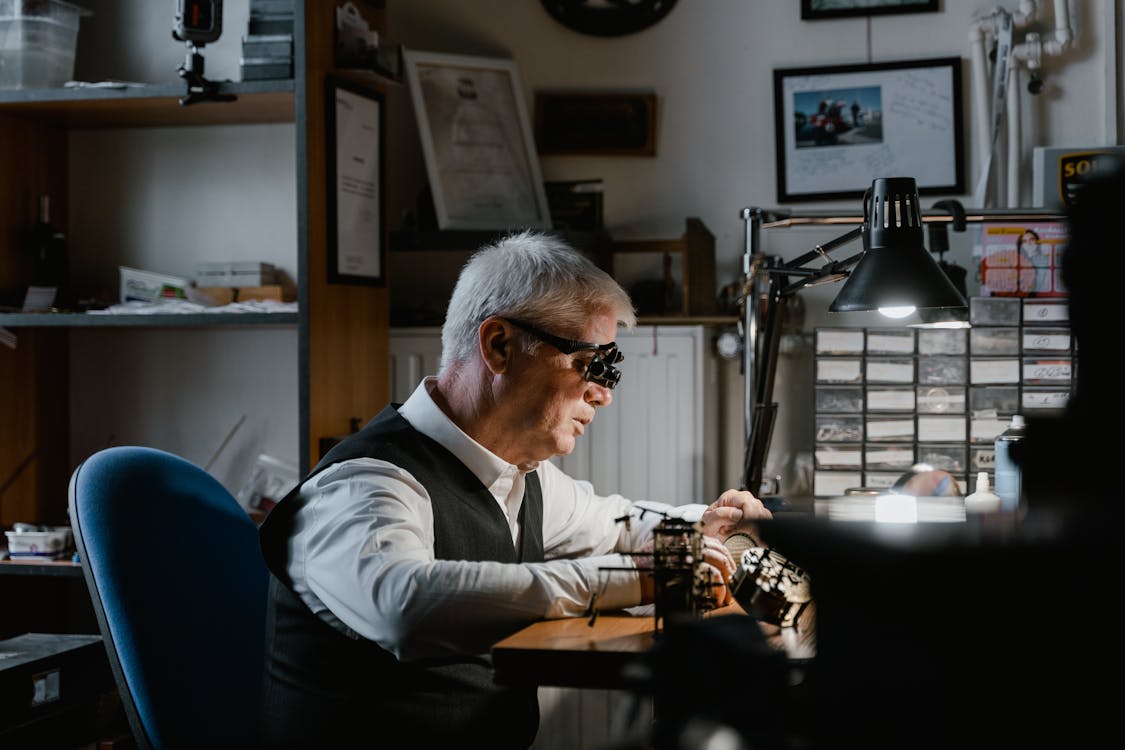
A professional who makes, services, restores, or repairs watches is most commonly called a watchmaker or watch repairer. The broader term is horologist, which describes someone who specializes in horology, the study and practice of timekeeping. A watch technician is another common job title, especially for repair and service work.
The terms overlap, but they are not always interchangeable. This guide explains what each title means, what watchmaking professionals do, which qualifications matter in the United States, and how to choose a qualified person to service your watch.
Written by Abdul Khader, researcher and writer at Top Reviewd. Last updated: November 5, 2026
Quick Answer: What Is a Watch Professional Called?
A person who makes or repairs watches is commonly called a watchmaker. A watch repairer or watch technician usually refers to someone whose work focuses on diagnosing, servicing, and repairing timepieces. Horologist is the broader term for a professional who studies, makes, repairs, or restores timekeeping devices, including watches and clocks.
What Is a Watch Professional Called?
The most familiar job title for a professional who works on wristwatches is watchmaker. Other titles include watch repairer, watch technician, and horologist. The American Watchmakers-Clockmakers Institute (AWCI) explains that professionals who make or repair timekeeping devices are called horologists. In the US occupational classification, O*NET groups watchmakers, watch technicians, and mechanical timepiece repairers under the occupation Watch and Clock Repairers.
The right word depends on the person’s actual work. Someone who replaces watch batteries at a retail counter, for example, may not have the same training or equipment as a watchmaker who overhauls a complicated mechanical movement. A title alone does not prove that a person is qualified to work on every type of watch.
Horologist vs Watchmaker vs Watch Repairer
These professional terms are related, but each places emphasis on a different part of the timekeeping trade.
| Professional Title | Typical Meaning | Common Work |
|---|---|---|
| Horologist | A person with knowledge or expertise in horology and timekeeping. | May study, make, repair, restore, assess, or research watches, clocks, and other timekeeping devices. |
| Watchmaker | A specialist who works on watch mechanisms and timepieces. | Assembly, adjustment, movement service, repair, restoration, and testing. |
| Watch Repairer | A professional focused on diagnosing and correcting watch faults. | Inspection, cleaning, repairs, replacement of worn parts, and timing checks. |
| Watch Technician | A technical job title used for watch servicing and repair roles. | Diagnostics, battery or cell changes, component replacement, servicing, and testing, depending on training. |
| Clockmaker | A specialist who makes, repairs, or restores clocks. | Clock mechanisms, cases, restoration, adjustment, and repair. |
| Watch Sales Associate | A retail professional who helps customers choose and buy watches. | Product information, sales, sizing, and basic customer support. This title does not automatically indicate movement-repair training. |
Is a Horologist the Same as a Watchmaker?
Sometimes the terms are used interchangeably in everyday conversation, but horologist is broader. A watchmaker generally works directly with watches and their mechanisms. A horologist may also specialize in clocks, historical timepieces, the history of time measurement, or other timekeeping instruments. A watchmaker can accurately be described as a horologist, but not every person who studies horology necessarily works as a watch repairer.
What Do You Call Someone Who Fixes Watches?
The most direct terms are watch repairer, watchmaker, and watch technician. In the US, O*NET lists job titles such as watch repair person, watch repair technician, watch technician, and watchmaker within the watch and clock repairer occupation. The actual work can range from battery replacement and basic repairs to full movement servicing, so ask about the technician’s experience with your specific watch and fault.
What Does a Watchmaker or Watch Repairer Do?
Watchmaking requires precision tools, close inspection, and a methodical approach. Depending on the watch and the professional’s training, common duties may include:
- Inspecting a watch and diagnosing why it has stopped, lost time, or developed another fault.
- Opening the case and examining the movement with a loupe and suitable tools.
- Disassembling, cleaning, lubricating, adjusting, and reassembling mechanical movement components.
- Replacing worn or damaged parts, such as a mainspring, stem, crown, crystal, or other component, when qualified to do so.
- Testing timekeeping accuracy and checking performance after repair.
- Replacing batteries and servicing electronic components on quartz watches.
- Checking water resistance when the watch, repair scope, and available testing equipment allow an appropriate pressure test.
- Restoring vintage watches and clocks, including sourcing or fabricating parts when the work requires it.
- Explaining the fault, repair options, parts availability, estimate, and service limitations to the customer.
These tasks are consistent with the US O*NET Occupational Profile for Watch and Clock Repairers, which includes cleaning, timing adjustment, disassembly, inspection, reassembly, lubrication, and repair of worn components. The exact work varies by specialty. A technician who mainly replaces batteries and straps may not be equipped to overhaul a high-grade mechanical chronograph.
What Is the Difference Between a Watchmaker and a Jeweler?
A jeweler works with jewelry and may also sell watches or arrange selected watch services. A watchmaker specializes in the construction, adjustment, or repair of timepieces. Some jewelry stores employ trained watchmakers or send repairs to an outside specialist, but not every jeweler is qualified to service a watch movement.
Before leaving a valuable watch at a jewelry store, ask who will carry out the work, whether the repair is performed in-house or sent to another service center, and whether the person handling the movement has relevant training. For brand-specific work, compare the independent repair option with the manufacturer’s authorized service route.
What Skills Does a Professional Watchmaker Need?
Professional watchmaking is a precision trade. Small components can be damaged by excessive force, dust, skin oils, or an incorrectly used tool. The work requires technical knowledge as well as careful handling and clear communication.
- Fine motor control: Handling tiny screws, gears, springs, hands, and other delicate components.
- Attention to detail: Recognizing wear, damage, misalignment, contamination, and assembly errors.
- Mechanical understanding: Knowing how movement components interact and how mechanical and electronic timepieces operate.
- Patience and problem-solving: Identifying the cause of a fault instead of replacing parts without diagnosis.
- Technical equipment knowledge: Using loupes, precision tools, timing equipment, cleaning machines, and appropriate testing equipment.
- Clear communication: Explaining estimates, parts availability, repair choices, limitations, and after-service care.
O*NET’s occupational profile highlights finger dexterity, arm-hand steadiness, precision, and close vision as important abilities for this work. It also lists repair, inspection, testing, and troubleshooting among the core work activities.
How Do You Become a Watchmaker or Horologist in the United States?
There is no single training route that applies to every country, employer, or watchmaking specialty. In the United States, people commonly enter the trade through a specialist watchmaking program, vocational or technical education, an apprenticeship, supervised workshop experience, or additional training through an industry organization or watch brand.
Watchmaking Schools and Technical Training
Formal training gives students structured practice with movement components, tools, adjustment, cleaning, and repair procedures. The AWCI List of Watchmaking and Clockmaking Schools describes different curricula, including traditional programs and the Swiss American Watchmakers Training Alliance (SAWTA) program. AWCI notes that traditional programs vary in length and often focus on mechanical wristwatch repair, with further study available in quartz, electronic, vintage, and clock repair.
The Horological Society of New York’s Watchmaking Schools and Programs Directory also lists US schools and part-time programs. Check each school’s current accreditation, curriculum, practical bench hours, tuition, financial support, and employer relationships directly because programs and admissions details can change.
Apprenticeships and Supervised Workshop Experience
Learning alongside an experienced watchmaker can build practical skills that are difficult to develop through reading alone. A supervised apprenticeship may include tool handling, movement identification, inspection, disassembly, cleaning, reassembly, regulation, customer records, and quality checks. The experience should involve progressive responsibility and feedback rather than unsupervised work on customers’ valuable watches.
Watchmaker Certification and Professional Credentials
In the United States, one credential to know is the AWCI’s CW21, Certified Watchmaker of the 21st Century. AWCI also offers the CMW21, Certified Master Watchmaker of the 21st Century. The CW21 assessment includes technical work involving automatic watches, quartz watches, chronographs, and other watchmaking competencies. Current certification requirements and continuing-education expectations should be checked with AWCI before applying or relying on a particular designation.
AWCI makes an important distinction: the general phrase “certified watchmaker” does not, by itself, identify which organization assessed a person’s skills. When a professional advertises a credential, ask who issued it, what the assessment covered, and whether the qualification is current. See the institute’s official CW21 Watchmaker Certification Standards and Watchmaker Certification Pathway.
What Is WOSTEP Training?
WOSTEP is an international watchmaking training foundation. Its watchmaker program is a full-time course that combines practical bench work and horological theory. It is one example of a structured training route, not a requirement for every watchmaker. Review the current WOSTEP Watchmaker Program for program length, entry information, schedule, and costs.
How to Choose a Reliable Watch Repair Professional
If your goal is to have a watch repaired, choose a professional whose experience matches the brand, movement, age, and type of repair. Use these checks before approving the work:
- Ask about relevant experience: Has the watchmaker worked on your brand, movement type, and specific fault before?
- Confirm the repair scope: Ask what is included, which parts may be replaced, and whether genuine or compatible parts will be used.
- Request a written estimate: Clarify labor, parts, diagnostics, taxes, shipping, and whether extra work requires your approval.
- Ask about testing: If the case is opened or seals are replaced, ask whether an appropriate water-resistance test is included. Do not assume a repaired watch is water resistant unless it has been tested as appropriate.
- Check the service warranty: Ask how long the repair is covered, what the warranty excludes, and whether you will receive documentation.
- Consider authorized service: For a high-value, vintage, complicated, or manufacturer-warranted watch, compare an authorized service center with an independent specialist who has relevant experience.
The AWCI provides a Find a Professional Directory that can help locate watchmakers and clockmakers in the United States and internationally. Use the directory as a starting point, then confirm the professional’s current credentials, brand experience, and ability to perform the repair you need.
When Should You Visit a Watchmaker?
Seek a professional assessment if a mechanical watch repeatedly stops, loses or gains much more time than usual, develops moisture under the crystal, suffers a hard impact, or has a loose crown or pusher. Avoid opening a sealed case or attempting movement repairs without the right tools and training. If your watch has stopped ticking, read our guide to How to Fix a Watch That Stopped Ticking for common causes and signs that professional help is needed.
Frequently Asked Questions
1. What Is a Watch Professional Called?
A professional who makes or repairs watches is commonly called a watchmaker. Horologist is a broader term for someone who specializes in timekeeping and may work with watches, clocks, or other timekeeping devices. A repair-focused role may also be called a watch repairer or watch technician.
2. What Do You Call Someone Who Fixes Watches?
The most direct titles are watch repairer, watchmaker, and watch technician. The right term depends on the person’s training, specialization, and the repairs they perform.
3. What Do You Call Someone Who Fixes Clocks?
A person who repairs or restores clocks is commonly called a clock repairer or clockmaker. Horologist can also describe a professional whose work covers clocks and watches.
4. Is a Horologist the Same as a Watchmaker?
The terms overlap, but horologist is broader. Watchmaker usually refers more specifically to someone who works on watch mechanisms. A horologist may also study or work with clocks, historical timekeeping, and other time-measuring devices.
5. Does a Watchmaker Need Certification?
Training and credential requirements vary by employer, country, and type of work. In the United States, AWCI offers watchmaker certifications such as CW21 and CMW21. Ask which organization issued a professional’s certificate and what skills it verifies.
6. Is a Jeweler Also a Watchmaker?
Not necessarily. A jeweler may sell watches or arrange basic services, but movement repair requires specific training and equipment. Ask who will carry out the repair and whether that person has relevant watchmaking experience.
7. What Is Horology?
Horology is the study, science, and craft of time measurement and timekeeping devices. It includes the design, making, repair, restoration, and history of watches and clocks. The AWCI Watch Owner FAQ provides a professional explanation.
8. How Do I Find a Qualified Watch Repairer?
Ask about relevant brand and movement experience, request a written estimate, check which parts will be used, and confirm what testing and service warranty are included. Professional directories and brand-authorized service networks are useful starting points, especially for high-value or complicated watches.
Related Watch Guides
- Topreviewd Watch Reviews and Guides
- Different Types of Watches Explained
- Mechanical vs Quartz Watch: Which Should You Choose?
- Sapphire Crystal vs Mineral Glass Explained
- How to Fix a Watch That Stopped Ticking
Editorial Note
This article explains common watchmaking and horology job titles and provides general guidance for choosing a repair professional. It is not a guarantee of any individual technician’s skill or a substitute for checking current credentials, service policies, and brand requirements. Training routes and professional titles differ by country and employer. Readers should confirm qualifications directly with the relevant school, certification body, repairer, or watch manufacturer.
Trusted Sources
- American Watchmakers-Clockmakers Institute: Watch Owner FAQ, including its explanation of horology and watchmaker certification.
- O*NET OnLine: Watch and Clock Repairers, 49-9064.00, for occupational titles, tasks, and work requirements.
- AWCI: US Watchmaking and Clockmaking School Programs, for training pathways and curriculum information.
- Horological Society of New York: Watchmaking Schools and Programs, for US program listings.
- WOSTEP: Watchmaker Program, for an example of structured international watchmaker education.
How This Guide Is Researched and Kept Current
This guide was reviewed against current search-result coverage of watchmaker and horologist terminology, career descriptions, occupational task information, training pathways, and professional certification. Definitions and US occupational descriptions are checked against AWCI and O*NET resources, while education information is cross-checked with AWCI, the Horological Society of New York, and WOSTEP. The article does not claim hands-on testing of watch repair providers or endorse a particular school. Certification names, program availability, admission requirements, and service policies can change, so readers should verify current details with the issuing organization before making a decision. Report corrections through the Topreviewd Contact Us Page.
About the Author
Abdul Khader is a watch enthusiast, researcher and writer, and the person behind Topreviewd. He writes about luxury and designer watches, automatic and quartz movements, materials, sizing, straps, crystals and water resistance, comparing watches across different price points so readers can judge what they get for the money. His approach is practical. He checks specifications, points out when sources disagree, and keeps published details separate from his own opinion. Read more on the About Page, or reach him through the Contact Us page.