Last Updated: October 23, 2026
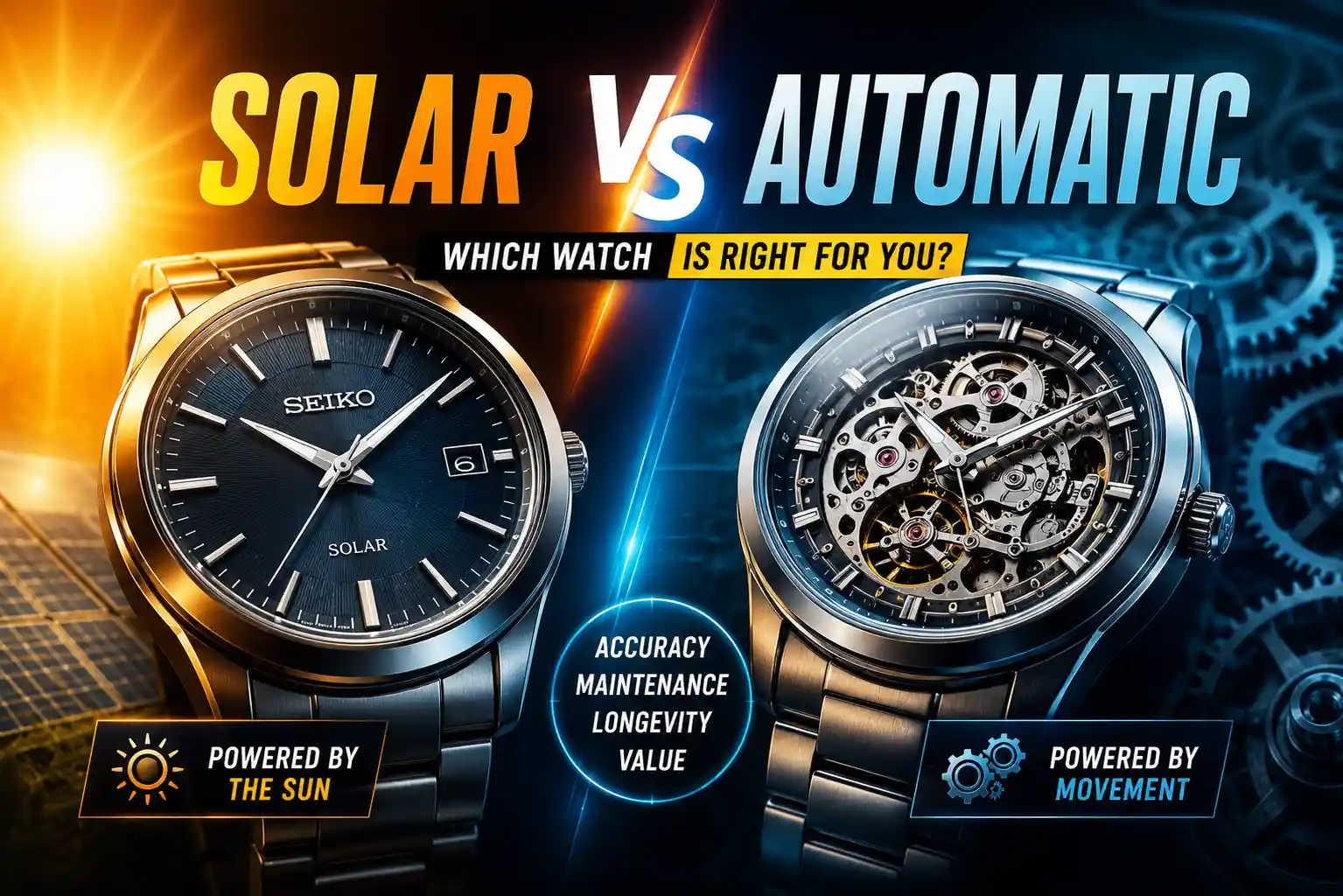
Choosing between a solar watch and an automatic watch depends on what you value most. Solar watches use light to power a quartz movement, while automatic watches use wrist motion to wind a mechanical mainspring. Solar usually wins for low-fuss timekeeping, while automatic watches appeal to people who enjoy traditional mechanical engineering. Neither is the right choice for every wearer.
This comparison explains how each movement works and compares accuracy, power reserve, charging habits, maintenance, durability and long-term ownership costs. The guidance uses manufacturer documentation and model specifications. Actual performance varies by movement and watch model, so use the exact reference and manual when making a final decision.
By the end, you can decide whether a solar watch, an automatic watch or one of each better suits your routine.
Key Takeaways
- A solar watch converts light to electricity to run a quartz movement. Its stated accuracy and dark-running reserve depend on the exact model.
- An automatic watch stores energy in a mainspring wound by wrist motion or, on many models, by manual winding. Its power reserve varies by calibre.
- Solar watches generally need less routine attention, but their rechargeable cell and movement can eventually need inspection or repair. Automatic watches need servicing according to the manufacturer’s guidance.
- Choose solar for accuracy and convenience. Choose automatic if the mechanical movement itself is part of what you value.
How We Compared These Watch Technologies
This is a research-based comparison of the two movement types, not a controlled laboratory test of every watch on the market. It considers manufacturer-published accuracy and power-reserve specifications, charging or winding requirements, servicing guidance, and practical ownership trade-offs.
Where performance varies by calibre or model, the article says so rather than presenting one number as universal. Check the precise model’s manual and specifications before you buy.
Quick Comparison: Solar Watch vs Automatic Watch
| Feature | Solar Watch | Automatic Watch |
|---|---|---|
| Power source | Light is converted to electricity for a quartz movement | Wrist motion winds a mechanical mainspring |
| Accuracy | Usually specified as seconds per month or year, depending on calibre | Usually specified as a mean daily rate, with variation from use and environment |
| Stored energy | Rechargeable cell, with reserve varying by model and features | Mainspring, with reserve varying by calibre |
| When stored | Needs enough light over time to maintain charge | Stops when its mainspring power reserve runs down |
| Routine care | Light exposure, ordinary cleaning, and service if performance changes | Careful handling and movement service as recommended by the manufacturer |
| Potential long-term repair | Rechargeable cell, electronic module or other components may require service | Mechanical movement may need cleaning, lubrication, adjustment or parts |
| Best suited to | Owners who prioritise accurate, low-fuss timekeeping | Owners who value a traditional mechanical movement |

What Is an Automatic Watch?
An automatic watch, also called a self-winding watch, is a mechanical watch powered by energy stored in a mainspring. Wrist motion turns a rotor that winds the spring, and many automatic models also allow manual winding through the crown. The gear train and escapement then release the stored energy to move the hands at a controlled rate.
An automatic does not use a battery or solar cell to power its timekeeping. Its mainspring, gear train and escapement regulate the release of stored mechanical energy, and the balance wheel oscillates at a rate specified by the movement.
Mechanical watchmaking has a long history, and its appeal today includes the engineering of the movement, rotor, mainspring and gear train. Some mechanical movements are tested and certified as chronometers. The Official COSC Chronometer Testing FAQ explains the testing framework and the criteria applied to the movements it certifies. Certification applies to the tested calibre and standard, not to every watch from a country or brand. Japanese brands such as Seiko and Citizen offer mechanical watches across different specifications and price points, so compare the model rather than generalising by origin.
An automatic watch needs enough stored spring energy to keep running. If it sits unworn until its power reserve runs out, it stops and may need winding and resetting. The reserve depends on the movement. Follow the manual to restart it instead of shaking the watch aggressively.
What Is a Solar Watch?

A solar watch is a type of quartz watch. A solar cell beneath or around the dial converts light into electricity, and a rechargeable cell stores that energy to run the quartz timekeeping system. Unlike a conventional battery-powered quartz watch, it usually does not need regular disposable-battery changes. It is not completely independent of stored energy, because the rechargeable cell can eventually age and may need service.
Citizen’s Eco-Drive is one well-known example of solar technology. Accuracy varies by calibre: many solar quartz watches publish monthly accuracy figures, while selected high-accuracy models publish annual figures. See Citizen’s The Citizen High-Accuracy Lineup for one specialised example. Do not assume that every solar watch shares the same accuracy rating or that a solar watch never needs attention. Confirm the exact model’s rated accuracy and follow its charging and care instructions.
Stored energy is another benefit, but the reserve is model-specific. For example, Citizen’s Official Eco-Drive Technology Guide says many Eco-Drive models run for more than six months on a full charge while noting that some models have a shorter reserve and others use power-saving features. The watch may need more light after extended storage, and charging time varies with the model and light conditions. For a broader explanation of power systems, read our How Watches Work Without Batteries guide, which covers solar, kinetic and automatic technologies.
Watch Movement Types: Where Solar and Automatic Fit In
Before picking a side in the automatic watch vs solar watch debate, it helps to see the full picture of watch movement types, because solar and automatic are only two branches of a bigger family tree.
- Mechanical movement: fully hand-wound or self-winding, no electricity at all. An automatic watch is simply a mechanical movement that winds itself.
- Conventional quartz movement: usually powered by a disposable battery and regulated by a vibrating quartz crystal. Accuracy and features vary by calibre.
- Solar quartz movement: uses light to generate electricity for the quartz timekeeping system, storing the energy in a rechargeable cell instead of relying on routine disposable-battery changes.
- Kinetic watch: a hybrid that uses wrist motion, like an automatic, to spin a tiny generator that charges a capacitor powering a quartz movement. Seiko’s Kinetic line is the best-known example.
When someone asks which watch movement is best, solar, automatic or quartz, the answer depends on priorities. Solar combines light charging with quartz timekeeping. A conventional battery-powered quartz watch also uses a quartz oscillator but needs a disposable battery. An automatic watch uses a mechanical movement wound by wrist motion. In many cases, solar and conventional quartz models offer better everyday timekeeping and lower routine upkeep than mechanical watches, but the exact accuracy, features and service requirements depend on the specific model. For a wider comparison, see our Mechanical vs Quartz Watch guide.
How They Work: The Real Difference Under the Dial
The easiest way to understand the solar vs automatic watch debate is to think about where the energy comes from.
An automatic watch is a closed mechanical system. Your wrist supplies kinetic energy, a rotor converts that motion into tension on a mainspring, and the mainspring slowly releases that tension through a gear train to move the hands. It is elegant, entirely mechanical, and completely free of electricity. This is also why people sometimes describe a self winding watch vs solar watch choice as tradition versus technology.
A solar watch is an electronic system with light as its energy source. A solar cell converts light into electrical energy, which is stored in a rechargeable cell and used to power a quartz timekeeping system. Quartz movements generally keep time more consistently than mechanical movements, but compare the specified accuracy for the exact calibre instead of assuming all solar watches have identical performance.
One relies on wrist movement to wind a spring. The other relies on light to generate electricity for a quartz movement. An automatic watch has no battery, while a solar watch uses a rechargeable energy-storage cell rather than a routine disposable battery. Their internal mechanisms are fundamentally different.
Automatic Watch Pros and Cons
Pros
- Mechanical craftsmanship that many collectors consider a form of miniature engineering art
- No battery or solar cell to degrade over the decades
- May remain serviceable for decades when maintained and when replacement parts and qualified service remain available
- The visible movement, especially through an exhibition caseback, adds real character to a specific watch caliber
- Some models attract collector interest, although resale value depends on the specific model, condition, originality, demand and service history
Cons
- Usually has greater day-to-day rate variation than quartz timekeeping, with actual accuracy depending on the calibre, regulation and conditions of use
- Stops when the mainspring’s stored energy runs out, with power reserve varying by calibre
- May require periodic professional servicing, with the recommended interval depending on the movement and manufacturer
- Mechanical timekeeping can be affected by magnetism, shock, temperature and how the mainspring is wound
- Generally a heavier upfront investment for comparable quality
Signs an Automatic Watch Needs Servicing
A few practical signs tell you when a service is due: the watch loses or gains noticeably more time than usual, the power reserve runs out faster than it used to, the rotor feels or sounds loose when you shake the watch gently, or moisture appears under the crystal. If the watch has stopped entirely, our guide on How to Fix a Watch That Stopped Ticking walks through the common causes before you assume it needs a full service.

Solar Watch Pros and Cons
Pros
- Quartz timekeeping generally offers steadier everyday accuracy than a mechanical movement, with the exact rating depending on the calibre
- Routine upkeep is generally low because it does not need regular disposable-battery changes, although the rechargeable cell or movement may eventually need service
- Many models provide a useful stored-energy reserve, but the duration depends on the calibre, features and charge level
- Can charge from sunlight and suitable indoor light, but the charging rate depends on brightness, duration and the exact model
- Generally more affordable than a comparable automatic watch, and common on field watch and sports watch models
Cons
- The rechargeable cell inside does age over many years and can eventually need replacement
- Availability varies by brand and collection, so shoppers looking for a specific luxury or dress style may have fewer solar options than mechanical ones
- Some owners find the appeal less romantic than a hand-wound mechanical piece
- Needs enough light exposure over time. A watch stored in darkness for a long period can run low once its model-specific reserve is depleted
How to Charge a Solar Watch That Has Run Low
If a solar watch slows, stops or shows a low-charge indicator after storage, follow the model’s charging instructions. Charging time depends on the watch, the light intensity, the dial design and the amount of stored energy remaining. A bright location may help, but avoid excessive heat: do not leave the watch on a hot dashboard or place it close to a high-heat lamp. Seiko’s Official Solar Watch Guidance warns that high temperatures can damage components, and Citizen’s Eco-Drive Charging Precautions advises keeping the watch charged and exposing it to light as directed. If it does not resume after the manual’s recommended charging procedure, ask an authorised service centre to check it rather than assuming the rechargeable cell is the only possible fault.
Solar or Automatic Watch: Which Is Right for You?
This is the part most comparison articles rush through, but it deserves real thought, because the right answer depends on how you actually live, not just which watch looks better in photos. People typing in “which is better solar or automatic watch” are usually really asking about their own daily routine, so these four scenarios should settle it.
Solar Watch vs Automatic Watch for Daily Use
If you wear one watch every day and want to minimise routine attention, a solar watch is often the more convenient choice. You may need to reset the time less often, and it does not need regular disposable-battery changes. It still needs adequate light exposure and may require service in the future. This convenience is one reason light-powered movements are popular in field and everyday watches.
Which Watch Is Better for Travel Solar or Automatic?
A solar watch can be convenient for travel because it may gain charge from suitable light encountered along the way, but charging speed depends on brightness, exposure time and the model. Do not rely on cabin lighting alone to fully recharge a low watch. An automatic may stop if it remains unworn beyond its power reserve, which differs by calibre, and then need winding and resetting. If you travel often, compare both the power-reserve specification and the manufacturer’s charging guidance.
Best Solar Watch or Automatic Watch for Beginners
If this is your first serious watch and you are not sure whether mechanical watches will hold your interest long-term, a solar watch is the safer starting point. It is forgiving, accurate, and low-cost to own. You can always add an automatic watch to your collection later once you know you enjoy the ritual of winding and setting one.
Automatic vs Solar Watch for Collectors
For collectors, the appeal of an automatic watch has little to do with practicality. It is about craftsmanship, heritage, and the satisfaction of owning something built the same way watches were built two centuries ago. If you already appreciate mechanical objects, a self-winding movement will likely mean more to you than a few extra seconds of monthly accuracy. Our brand reviews of Is Invicta a Good Watch Brand and Is Tissot a Good Watch Brand cover two popular starting points for automatic collectors at different price points.

Accuracy: Are Solar Watches More Accurate Than Automatic Watches?
Solar watches use quartz timekeeping, which generally delivers steadier everyday accuracy than a mechanical movement. The exact rating still depends on the calibre. Some solar quartz models state accuracy in seconds per month, while specialised high-accuracy models may specify performance in seconds per year. For an example of the latter, see Citizen’s The Citizen High-Accuracy Lineup. These figures apply to particular models, not to every solar watch.
Mechanical watch accuracy is usually expressed as a mean daily rate, and actual results can vary with how fully the mainspring is wound, how long the watch is worn, its position, temperature, shock and magnetism. A COSC-certified mechanical chronometer is tested against a defined standard, but that does not mean every automatic movement has the same rate or that a watch will behave identically in all conditions. Read the exact model specification and the manufacturer’s guidance.
Seiko’s Official Explanation of Mechanical Watch Accuracy describes these real-world influences. Solar is usually the more convenient choice if you want to minimise time-setting, while an automatic can still be an excellent choice if you accept normal mechanical rate variation. For a broader movement comparison, see our Mechanical vs Quartz Watch guide.
Which Watch Needs Less Maintenance Solar or Automatic?
Solar watches generally need less routine attention than mechanical watches, but they are not maintenance-free. The rechargeable cell gradually ages, and the movement, seals or other components can eventually need inspection or repair. The timing varies with the watch, its charging history, storage conditions and use, so avoid assuming every cell will last a fixed number of years. Follow the manual and have the watch checked if its reserve falls sharply or it no longer charges normally.
Automatic watches need periodic attention, but there is no single service interval that applies to every calibre. Follow the instruction manual or the brand’s service guidance. For example, Seiko’s Official Mechanical Watch FAQ recommends periodic examination and cleaning for the movements it discusses. Service costs vary by brand, movement complexity, parts availability and local labour, so compare the maintenance guidance for the exact model. Solar watches also need care and may eventually require inspection or repair of the rechargeable cell or electronics.
Power Reserve and Storage: What Happens When You Stop Wearing It?
Power reserve is one of the easiest differences to overlook when buying a watch. An automatic stores energy mechanically in its mainspring. A solar watch stores electrical energy in a rechargeable cell. Neither should be described using one reserve figure for every model.
Storing a Solar Watch in Darkness
A fully charged solar watch may run for months without light, depending on its movement and power-saving features. Once the stored energy is depleted, it needs suitable light exposure according to the manual. If you are putting it away for a long period, check the manufacturer’s storage and charging instructions, and avoid excessive heat while charging. Citizen’s Eco-Drive Guide notes that reserve varies by model and some models use power-save functions.
Storing an Automatic Watch in a Drawer
An automatic watch stops when the mainspring’s stored energy runs out. The reserve depends on the calibre and may be longer or shorter than the examples often quoted for basic movements. To restart it, follow the manual for winding and setting the time and date. Do not shake the watch aggressively to make it run.
Solar vs Automatic Watch: Total Cost of Ownership
The purchase price tells only part of the cost. A solar watch can reduce routine battery-change expenses and usually needs little user intervention, but a rechargeable cell, electronic module or seals may eventually require service. An automatic avoids batteries but has a more complex mechanical movement that may need cleaning, lubrication, adjustment and parts over time. Neither type is guaranteed to be cheaper for every owner.
What to Compare Before Buying
Build a Simple Ownership-Cost Estimate
For a fair comparison, start with the purchase price and add expected servicing, likely replacement parts, and any rechargeable-cell or module repair that the manufacturer says may apply. Use the recommended service guidance and a local written estimate where possible. This is a planning exercise, not a guarantee that a particular repair will be needed within a fixed period.
- Purchase price: Compare watches in the same budget and quality range rather than assuming all solar watches cost less than automatics.
- Manufacturer service guidance: Check the stated service and inspection recommendations for the exact calibre.
- Future component support: Ask whether authorised service is available and whether replacement cells or movement parts can be sourced.
- Use and storage: A solar watch that receives insufficient light or an automatic that sits unworn may need extra attention for different reasons.
- Warranty terms: Read what is covered, for how long, and which kinds of wear or damage are excluded.
For either type, follow the maker’s care instructions and ask for a written estimate before approving a repair. That gives you a better ownership-cost comparison than relying on a generic servicing interval or a claim that one movement lasts forever.
Solar vs Automatic Watch Durability Comparison
Some mechanical watches can remain serviceable for decades when maintained and when parts remain available. That can support sentimental value, but resale value is not guaranteed and depends on brand, condition, originality, demand and service history. The crystal also matters to day-to-day appearance: sapphire resists surface scratches better than ordinary mineral glass, though it can still chip or crack. Our guide to Sapphire Crystal vs Mineral Glass compares those materials.
Light-powered watches have been on the market for decades. Citizen says it released a light-powered analogue watch in 1976 and continues to develop its Eco-Drive system. That history shows solar technology is established, but it does not mean that every model will last a certain number of years without service. A solar watch may eventually need a rechargeable-cell, module or other component repair. An automatic watch may need mechanical servicing and replacement parts over its life. Overall longevity depends on the specific model, use, storage and maintenance rather than movement type alone. See Citizen’s Official Eco-Drive Technology Overview for its history and model-dependent power features.
Related Comparisons Worth Knowing
The solar versus automatic debate is really one branch of a bigger conversation about how watches keep time. If you are also weighing a traditional quartz option, our Automatic Watch vs Quartz guide walks through the accuracy, cost, and lifestyle tradeoffs in more detail. Quartz movements share the accuracy advantage of solar watches but rely on a disposable battery instead of light, which is often the deciding factor for buyers comparing the two.

Why the Exact Model Specification Matters
“Solar” and “automatic” describe how a watch gets its energy, not its overall build quality. Two watches with the same movement category can still differ in stated accuracy, reserve, case construction, water resistance, warranty and service support. Compare the manufacturer’s published specifications and manual for the exact reference before deciding.
FAQs (Because People Keep Asking)
1. Which is better, a solar watch or an automatic watch?
Neither is universally better. Solar watches often have an advantage in timekeeping consistency and low routine upkeep, provided they receive enough light and are maintained as directed. Automatic watches appeal to buyers who value a mechanical movement and its craftsmanship. Compare the exact models and choose based on the trade-offs that matter to you.
2. Are solar watches more reliable than automatic watches?
Solar watches are generally more accurate in everyday timekeeping because they use a quartz timebase, but reliability also depends on the exact movement, condition and use. A solar watch can run low if it does not receive enough light, and an automatic can stop when its mainspring reserve runs out. Follow the model’s care instructions and compare its published specifications.
3. How long do solar watches last?
A well-maintained solar watch may remain functional for many years, but lifespan varies by model, use and storage. The rechargeable cell, electronic module, seals or other components can eventually need service, and the cost depends on the watch. Ask an authorised service centre about parts and repair options for the exact reference.
4. Do automatic watches need batteries?
No. Automatic watches run entirely on mechanical energy generated by wrist motion, with no battery, solar cell, or electronic components involved at all.
5. Which Watch Is More Accurate, Solar or Automatic?
Solar quartz watches generally keep more consistent time than automatic mechanical watches, but the exact result depends on the calibre. Compare the stated accuracy for each model and note the measurement period and conditions. Some specialised solar models specify annual accuracy, while mechanical rates are normally described as a daily rate.
6. Is a solar watch good for everyday use?
Often, yes. Solar watches can be well suited to daily wear and travel because they use quartz timekeeping and need no regular disposable-battery replacement. They still need enough light over time, and model-specific charging instructions should be followed.
7. Can a solar watch run without sunlight?
Yes, while it has enough stored energy. The amount of time it can run in darkness depends on the model’s full-charge reserve and any power-saving features. Indoor light can charge many solar watches, though charging is typically slower than under bright sunlight. Follow the manufacturer’s guide and avoid exposing the watch to excessive heat while charging.
8. Do automatic watches require servicing?
Yes, but the recommended interval varies by brand and calibre. Follow the instructions for the exact watch. A service may include inspection, cleaning, lubrication, adjustment and replacement of worn components where necessary. Service costs and suggested schedules differ by movement and manufacturer.
9. What are the disadvantages of a solar watch?
The main trade-offs are the need for suitable light exposure, a rechargeable cell that can lose capacity over time, and model or style availability that varies by brand. If the watch has been stored in darkness or no longer holds charge, follow the manual and consult an authorised service centre if charging does not restore normal operation.
10. Are automatic watches worth buying?
An automatic can be worth buying if you enjoy its mechanical construction and accept that the rate may vary and the movement may need service. If you mainly want accurate, low-fuss timekeeping, solar or conventional quartz is often more practical. Compare the particular model’s price, specifications and service support.
11. Is a Solar Watch Better Than an Automatic Watch for Everyday Accuracy?
Usually, yes. Solar watches use quartz timekeeping and generally offer steadier everyday accuracy, but model specifications matter. A high-grade automatic may perform better than an entry-level mechanical movement, so compare the accuracy ratings and test conditions instead of relying on the movement label alone.
12. Should I buy a solar or automatic watch?
Buy a solar watch if you want a low-maintenance, highly accurate everyday piece. Buy an automatic watch if you value mechanical craftsmanship and do not mind occasional servicing and resetting.
13. Do automatic watches stop if not worn?
Yes. Once the mainspring’s stored energy runs out, typically within 36 to 70 hours depending on the movement’s power reserve, the watch stops until it is worn again or manually wound.
14. Is a solar watch worth buying?
For most everyday owners, yes. The combination of strong accuracy, low running costs, and minimal upkeep makes a solar watch one of the more practical purchases in modern watchmaking.
15. Which Watch Movement Is Best, Solar, Automatic or Quartz?
There is no single best choice. Solar is a type of quartz watch that uses light instead of a routine disposable battery. Conventional quartz uses a disposable battery, while automatic watches use a spring-driven mechanical movement. Choose solar for low-fuss quartz timekeeping, conventional quartz for a simple and often affordable option, or automatic for the mechanical experience.
16. Solar vs Automatic Watch Which Lasts Longer?
Both types may remain functional for many years, but there is no guaranteed lifespan. An automatic may need movement service and parts, while a solar watch may eventually need a rechargeable cell, electronic module or other component service. The outcome depends on the model, condition, use, storage and parts availability.
17. Automatic Watch vs Solar Watch Pros and Cons
An automatic watch offers mechanical craftsmanship and a traditional movement, but it can stop when unworn and may need periodic servicing. A solar watch offers quartz timekeeping and generally low routine upkeep, but it needs suitable light and its rechargeable cell and electronics may eventually require service. Compare specific models against your habits, budget and preferences.
18. Do Solar Watches Need Direct Sunlight?
Not necessarily. Many solar watches can charge from suitable indoor lighting as well as sunlight, but charging is generally faster in brighter light and the requirements vary by model. Check the instruction manual and avoid excessive heat while charging.
19. Does a Solar Watch Battery Ever Need Replacing?
A solar watch uses a rechargeable energy-storage cell, not a regular disposable watch battery that needs routine replacement. The cell can lose capacity over time, and the watch may eventually need inspection or repair. Serviceability and part availability depend on the model, so consult an authorised service centre if the watch no longer holds charge.
20. Can You Manually Wind an Automatic Watch?
Many automatic watches also support manual winding through the crown, but the procedure and permitted amount of winding vary. Follow the instructions for your calibre. If the watch has stopped, do not force the crown or shake the watch hard to restart it.
21. Is a Solar Watch Better If You Do Not Wear a Watch Every Day?
It can be, as long as the watch receives enough light over time and its stored charge is maintained. A solar watch can also run out of energy after prolonged darkness, while an automatic stops when its mainspring reserve runs down. If you rotate several watches, consider each model’s reserve, charging instructions and how you store it.
Final Verdict
If you want a watch that keeps time with little routine input, a solar watch is often the smarter everyday choice, provided you follow its charging instructions. Its dark-running reserve depends on the model. If you value mechanical craftsmanship and enjoy winding and setting a watch, an automatic can be more satisfying, provided you accept its rate variation and service needs.
There is no universal winner in the solar vs automatic watch comparison. Choose solar if you prioritise quartz timekeeping, convenient charging and relatively low routine upkeep. Choose automatic if you value the mechanics, heritage and experience of a spring-powered movement. In either case, the exact watch’s quality, usage, care and availability of parts have more bearing on long-term ownership than the movement label alone. For more practical watch advice, explore Topreviewd Watch Reviews and Guides.
Related Articles:
- Types of Watches Explained: The Complete Guide
- Automatic Watch vs Quartz: Accuracy, Cost and Care
- Mechanical vs Quartz Watch: Which One Should You Buy?
- How Do Watches Work Without Batteries
- Sapphire Crystal vs Mineral Glass for Watches Explained
- How to Fix a Watch That Stopped Ticking
- Is Invicta a Good Watch Brand
- Is Tissot a Good Watch Brand
- Giorgio Armani vs Emporio Armani vs Armani Exchange
- Armani Exchange vs Emporio Armani
- Armani Exchange Watches
How This Guide Is Researched and Kept Current
This guide compares solar and automatic movements using manufacturer documentation, published movement specifications and care instructions, including guidance from Citizen’s Eco-Drive Technology Guide, Seiko’s Official Solar Watch Guidance, Seiko’s Mechanical Accuracy FAQ, and the COSC Chronometer Testing FAQ. Published accuracy, power reserve, service needs and charging instructions vary by calibre and model. This is a research-based buyer’s guide, not a controlled side-by-side laboratory test of every watch. Check the exact reference and its manual before purchase or repair. The article was reviewed on October 23, 2026. If you spot a factual error or an outdated specification, contact the team through Topreviewd Contact Us.
About the Author
Abdul Khader writes watch reviews and practical buying guides for Topreviewd, covering movement types, materials, accuracy, care and long-term ownership. His approach is to compare published specifications, explain meaningful trade-offs, and separate manufacturer claims from general guidance so readers can assess watches across different price points.
Read more about the site on the About Topreviewd page or send a question through Contact Topreviewd.