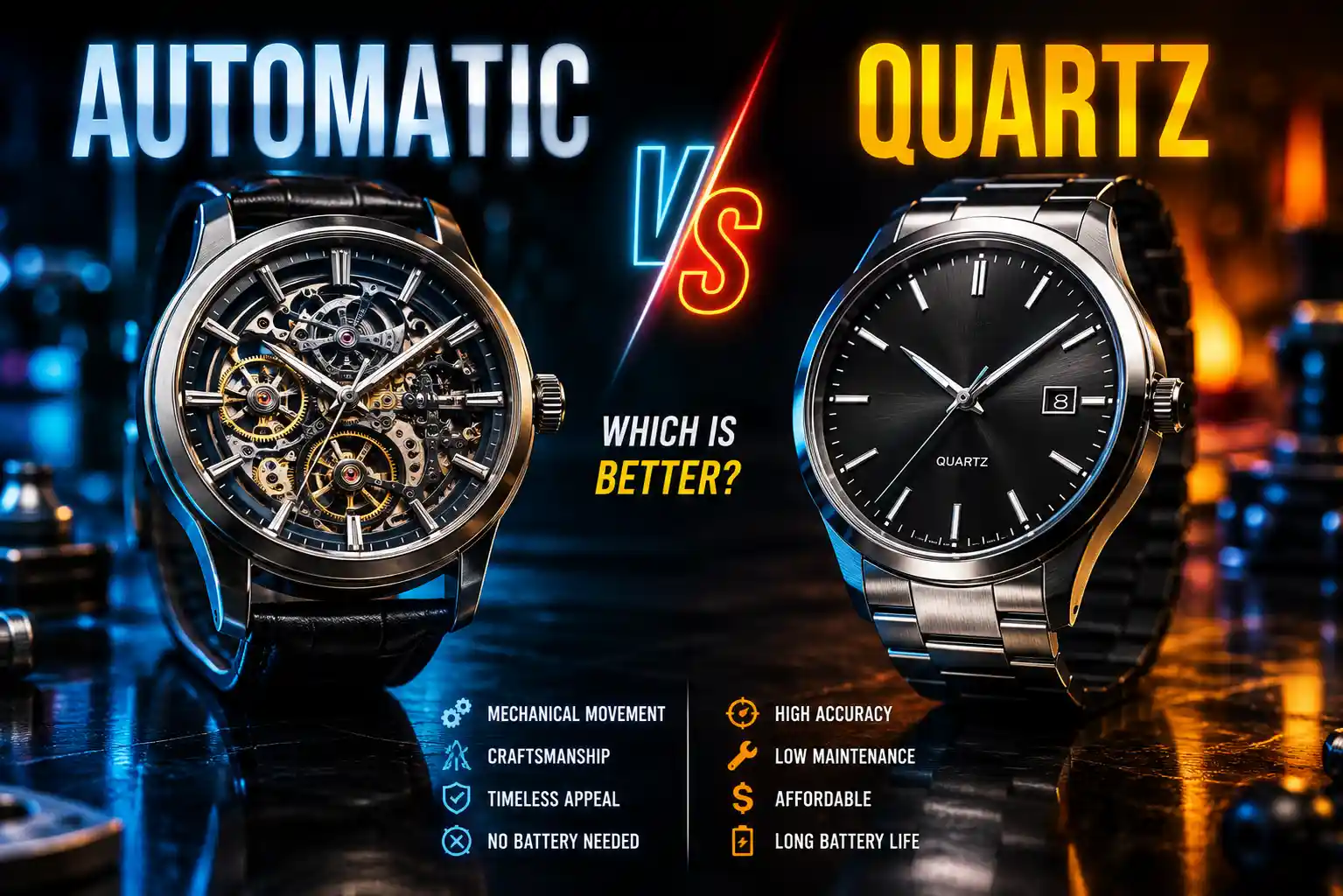
If you’ve spent any time browsing watches lately, you’ve probably run into this debate more than once. Someone in a forum swears automatics are the only “real” watches. Someone else points out that a $30 quartz keeps better time than a $3,000 mechanical piece. Both of them are right, which is exactly why the Automatic Watch vs Quartz question trips people up.
Here’s the short version: automatic watches run on a mechanical movement powered by your wrist motion, while quartz watches use a battery and a vibrating crystal to keep time. Automatics are more about craft, tradition, and feel. Quartz is about precision, low maintenance, and price. Neither is objectively better. It depends on what you actually want from a watch, and whether you’re weighing a quartz vs automatic watch for daily use or for a collection piece changes the answer quite a bit.
Let’s break down what’s really going on inside each one, so you can make a call you won’t second-guess in six months.
Key Takeaways
- A quartz watch typically stays accurate within 15 seconds a month, while even a quality automatic runs -20 to +20 seconds a day.
- An automatic watch stops within 24 to 48 hours if left unworn, since it relies entirely on wrist motion to stay wound.
- Automatics need servicing every 3 to 5 years, typically $150 or more. Quartz only needs a battery change every 1 to 2 years.
- Neither is objectively better. Automatics reward craftsmanship and heritage, quartz rewards accuracy and low maintenance.
How We Compared These Watch Technologies
This comparison goes beyond technical specifications to evaluate how each watch technology performs in everyday ownership. I assessed accuracy, maintenance requirements, durability, convenience, servicing needs, power source, long-term reliability, operating costs, and suitability for different lifestyles.
Rather than focusing only on manufacturer claims, this guide explains the practical advantages and limitations of each technology so buyers can choose the option that best matches their needs.
Watch Movement Explained
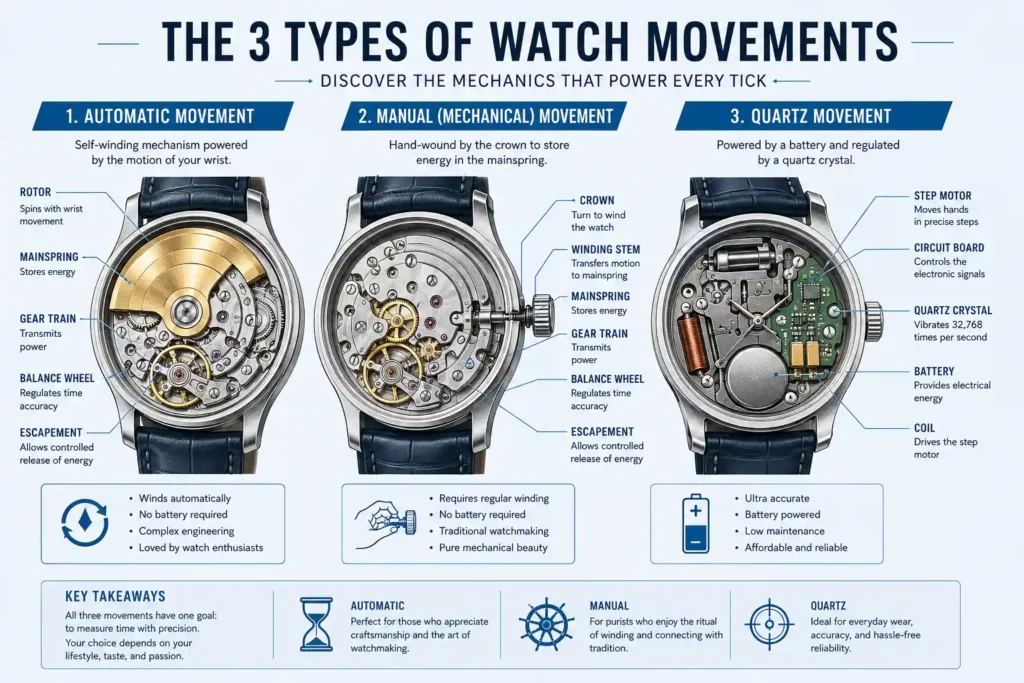
Before comparing the two, it helps to know what “movement” actually means. A movement (sometimes called a caliber) is the engine of the watch, the internal mechanism that makes the hands move and keeps time. Every watch falls into one of three movement categories:
- Automatic (self-winding mechanical): powered by wrist motion
- Manual (hand-wound mechanical): powered by winding the crown yourself
- Quartz (electronic): powered by a battery and a crystal oscillator
Everything else in this Automatic Watch vs Quartz comparison, price, accuracy, and upkeep, comes down to which of these three engines is sitting inside the case. Automatic and manual movements are both considered “mechanical,” which is why you’ll often see mechanical vs quartz watch used almost interchangeably with automatic vs quartz. When people ask about automatic vs mechanical watch differences, they’re usually just asking about winding: automatics wind themselves through wrist motion, while manual mechanical watches need the crown turned by hand, typically once a day.
When you’re comparing automatic watches vs quartz watches as categories rather than individual models, it really is a choice between two philosophies. One runs on stored mechanical energy. The other runs on electronics. Neither is a compromise; they’re just built for different priorities.
What Is an Automatic Watch?
An automatic watch is a type of mechanical watch that winds itself using the natural movement of your wrist. No battery, no charging cable, no app. Just gears, springs, and physics.
Inside the case sits a small weighted disc called a rotor. As you move your arm through the day, the rotor spins and winds the mainspring, which stores energy and slowly releases it to power the watch. This is why automatics are sometimes called “self-winding watches.” The next section below covers exactly how that rotor and mainspring system works, piece by piece.
An automatic watch movement is built from a handful of core parts working in sequence: the rotor collects energy from motion, the mainspring stores it, and the escapement releases it at a controlled rate to drive the hands. It’s a self-contained system with no wires and no software, just mechanical engineering that’s been refined for centuries.
What draws people to automatics isn’t really the timekeeping. It’s the engineering on display, the smooth sweep of the second hand, and the fact that a well-made one can run for decades, sometimes generations, with proper care.
What Is a Quartz Watch?
A quartz watch runs on a battery and a tiny piece of quartz crystal. When electricity from the battery passes through the crystal, it vibrates at a fixed, extremely stable frequency, exactly 32,768 times per second. A circuit counts those vibrations and converts them into the steady ticks you see on the second hand.
This is the same basic technology used in most everyday clocks and phones, and it’s why quartz watches are so accurate and so cheap to produce at scale. There’s no mainspring, no rotor, no need for you to keep it moving. Replace the battery every year or two, and it keeps going. This is really the heart of the Automatic Watch vs Quartz split: mechanical energy versus electronic precision.
A quartz watch movement is a fairly simple electronic system by comparison. A battery powers a circuit, the circuit drives the quartz crystal’s vibration, and a small stepping motor translates that vibration into the ticking motion of the hands. Fewer moving parts means fewer things that can wear out or need adjustment.
The next section walks through exactly how that circuit and crystal system works, step by step.
Quartz technology changed the entire watch industry when it arrived commercially in the 1970s, a period the industry still refers to as the “quartz crisis,” since it nearly wiped out traditional Swiss watchmaking almost overnight. You can read more about how that shift played out in this Smithsonian Overview of the Quartz Revolution.
How Automatic Watches Work
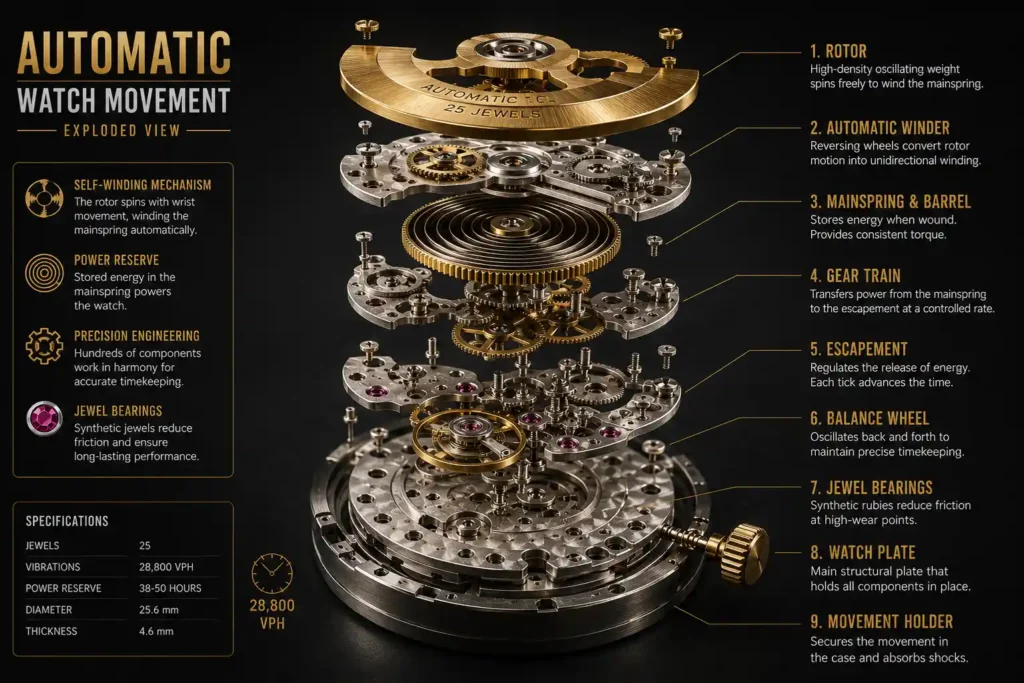
To really get why automatic watches feel different, it helps to know what’s happening under the dial.
The mainspring is a coiled strip of metal that stores energy, similar to a tightly wound rubber band. As it unwinds, it releases energy in controlled bursts.
The rotor is the weighted half-moon-shaped piece that swings freely as you move. It’s connected to a winding mechanism that tightens the mainspring automatically.
The escapement regulates how fast that stored energy is released. It’s the part that makes the ticking (or in a good automatic, the smooth sweeping) motion of the hands possible. Without it, the mainspring would unwind all at once.
Jewel bearings, usually made from synthetic rubies, reduce friction between moving parts. More jewels generally mean smoother operation and less wear over time, though jewel count alone isn’t a perfect measure of quality.
Power reserve is another term worth knowing. It refers to how long the watch keeps running on stored energy alone, once you take it off. Most automatics offer a power reserve of 38 to 48 hours, though some higher-end models push past 70 hours or more. A longer power reserve means more forgiveness if you skip a day of wearing it.
All of this works together without a single battery. It’s a self-contained mechanical system, which is part of why automatic movements are often described as small feats of engineering. Our guide to Different Types of Watches covers how this compares with manual and quartz movements across the wider watch landscape.
How Quartz Watches Work
Quartz movements are a lot simpler mechanically, even though the science behind them is arguably more advanced.
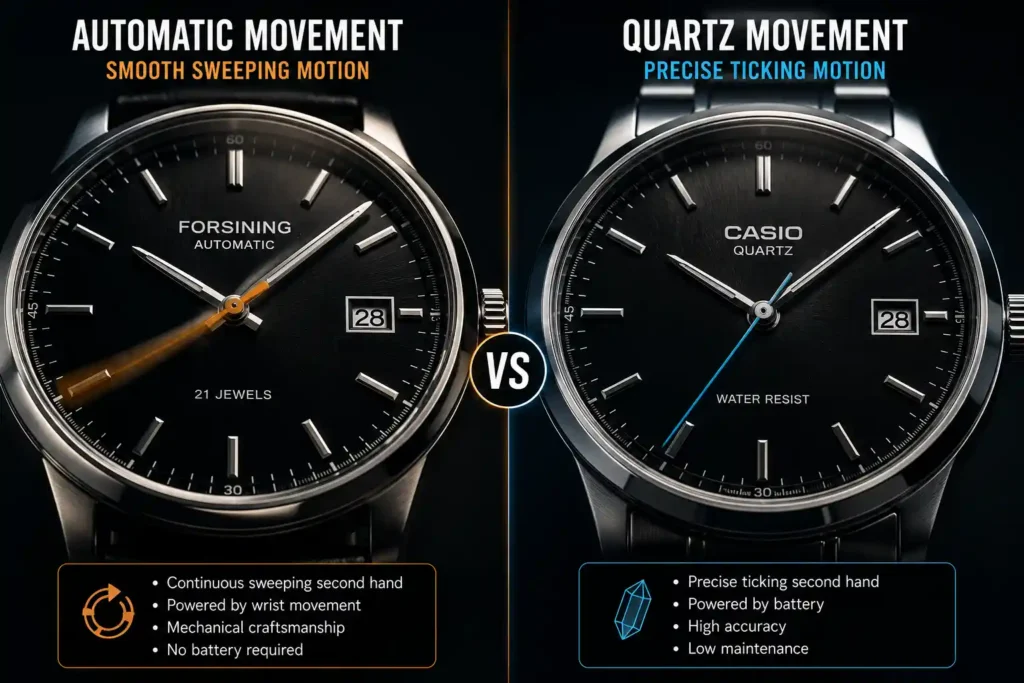
A battery-powered watch like this relies on a small battery to run its internal circuit. The current passes through the quartz crystal, causing it to vibrate at a fixed rate. A tiny circuit board counts those vibrations and sends a pulse to a small motor, which moves the second hand forward, usually once per second. That’s the ticking second hand you notice on almost every quartz watch, a distinct one-step-per-second motion driven by an electronic pulse rather than continuously released mechanical force.
Compare that to the sweeping second hand on most mechanical and automatic watches, which glides smoothly around the dial instead of stepping. That fluid motion comes from the escapement releasing energy in rapid, tiny increments, several times per second rather than once. It’s one of the easiest ways to tell a mechanical watch from a quartz one just by glancing at the dial.
Because the quartz process is electronic rather than mechanical, there’s far less that can go wrong or drift out of calibration. That’s the entire reason quartz watches are so reliable for daily accuracy. For more on the battery-free alternative, see How do Watches Work Without Batteries, which compares this directly against automatic and manual movements.
Most mainstream quartz movements come from Japanese movement manufacturers like Seiko, Citizen, and Miyota, known for reliable, affordable calibers that balance accuracy and price well. Swiss movement brands also produce their own high-grade quartz calibers for the luxury segment, built and regulated to the tighter tolerances required for “Swiss Made” certification. So the automatic vs quartz conversation isn’t strictly a Swiss-versus-everyone-else question either.
Why Don’t Automatic Watches Need Batteries
Automatic watches don’t need batteries because they generate their own power. A weighted rotor inside the case spins with wrist movement and winds the mainspring, which stores mechanical energy the same way a wound-up spring does. That stored energy then drives the gears and hands, making the entire system self-sufficient. As long as you wear the watch regularly, it never needs an external power source at all.
Automatic Watch Accuracy vs Quartz Watch Accuracy
This is where the gap is biggest, and where quartz has a clear technical edge.
A quality automatic watch typically runs somewhere between -20 and +20 seconds per day, depending on the movement grade. Higher-end Swiss automatics with COSC chronometer certification are held to a tighter standard, around -4 to +6 seconds per day. You can check the official certification criteria through COSC, the Swiss Chronometer Testing Institute.
A basic quartz watch, by comparison, is usually accurate to within 15 seconds per month. That’s a massive difference, and it’s the single stat people quote most often when the Automatic Watch vs Quartz debate comes up online. A $50 quartz watch will out-tick a $10,000 automatic over the course of a year, every time.
So why do people still pay a premium for automatics if quartz is objectively more precise? Because accuracy isn’t the whole point of buying one. It’s a bit like asking why anyone drives a manual transmission car when automatics shift faster. The appeal is in the mechanism itself, not just the outcome.
Automatic Watch Lifespan vs Quartz Watch Lifespan
An automatic watch lifespan can span decades, even generations, provided it’s serviced roughly every 3 to 5 years. The moving mechanical parts wear down gradually through friction, so periodic cleaning, oiling, and adjustment by a watchmaker is what keeps the movement accurate and running smoothly over the long haul. Neglect that servicing and dried lubricant will eventually cause premature wear.
A quartz watch lifespan typically runs 10 to 20 years or more with almost no attention beyond battery changes. Since there are far fewer moving mechanical parts to wear down, quartz movements tend to keep working reliably long after the case, strap, or seals have started to show their age.
Maintenance and Lifespan
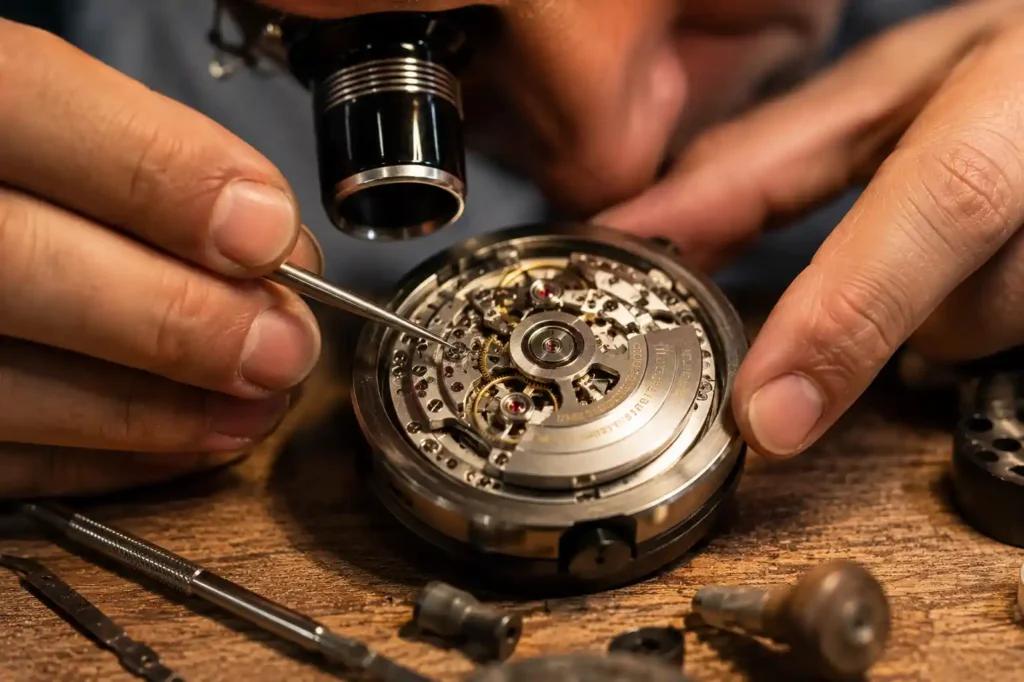
Automatic watches need periodic servicing, generally every 3 to 5 years, where a watchmaker cleans, oils, and adjusts the internal parts. Skipping this can shorten the life of the movement, since dried lubricant causes extra friction and wear. Servicing costs vary widely, from around $150 for basic brands to several hundred dollars for luxury Swiss pieces. In exchange, a well-maintained automatic can genuinely last a lifetime, and many get passed down as heirlooms.
Quartz watches need almost nothing. Replace the battery every one to two years, and that’s typically it. There’s no oiling, no regulating, no trip to a watchmaker. On the maintenance front alone, the Automatic Watch vs Quartz comparison isn’t really close.
If your automatic watch ever stops running unexpectedly, our guide on How to Fix a Watch That Stopped Ticking walks through the common causes before you assume it needs a full service.
Bottom line: quartz wins on convenience by a wide margin. Automatic wins if you don’t mind the occasional trip to a watchmaker as part of owning the piece.
Price and Value
Quartz movements are cheaper to manufacture, which is why entry-level quartz watches start well under $100 and remain reliable. You’re mostly paying for design, brand, and materials rather than the movement itself.
Automatic movements cost more to produce because of the number of precision parts involved and the skilled labor required to assemble and regulate them. Entry-level Swiss automatics generally start around $300 to $500, while automatics from Japanese brands can be found for less. As you move up into luxury Swiss automatic vs quartz comparisons, price becomes less about the mechanism and more about brand heritage, in-house complications, and finishing.
The automatic vs quartz watch price difference really starts at the movement level itself. Quartz movements are cheap and simple to mass-produce, keeping entry prices low. Automatic movements require precision parts and hand assembly, which pushes entry-level pricing higher before brand name or materials even factor in.
If you want to see where the value actually sits at different price points, our brand reviews of Is Invicta a Good Watch Brand and Is Tissot a Good Watch Brand break down specific automatic options at different price points worth considering.

Which Is Better for Everyday Use?
For an automatic vs quartz watch for everyday use, quartz is hard to beat on pure practicality. It doesn’t stop overnight if you take it off, it doesn’t need winding, and it handles knocks and temperature changes without much fuss.
Automatics require a bit more attention than automatic vs quartz watch for daily wear. If you don’t wear one for 24 to 48 hours, it will usually stop and need resetting (unless you own a watch winder, which is its own small investment). For people who wear the same watch daily and rarely swap pieces, that’s a non-issue; the rotor stays active, and the watch stays wound naturally. For people who rotate through several watches, it can get annoying fast.
On automatic watch vs quartz durability, both hold up well under normal daily wear. Automatics have more moving parts that can wear over time without servicing, while quartz movements have fewer components to fail in the first place. In practice, case material and water resistance matter more for everyday durability than the movement type itself.
Neither is fragile in a way that should worry you for normal daily use. It really comes down to how hands-on you want your relationship with your watch to be.

Automatic Watch vs Quartz for Beginners
For automatic watch vs quartz for beginners, quartz is generally the easier entry point. It’s forgiving, affordable, and comes with no learning curve; you just wear it. Once you’re more familiar with watches generally, moving into automatics later lets you appreciate the mechanics without the early frustration of winding schedules and servicing intervals.
Pros and Cons Table
| Automatic Watch | Quartz Watch | |
|---|---|---|
| Accuracy | Good, not perfect (-20/+20 sec/day typical) | Excellent (within 15 sec/month) |
| Maintenance | Servicing every 3-5 years | Battery swap every 1-2 years |
| Price (entry level) | Higher, generally $300+ | Lower, often under $100 |
| Power source | Wrist movement, no battery | Battery required |
| Power reserve | 38-48+ hours off-wrist | Not applicable (always running) |
| Longevity | Decades with care | Decades, minimal care |
| Stops if unworn | Yes, within 1-2 days | No |
| Craftsmanship appeal | High, visible mechanics | Low, functional design |
| Second-hand motion | Smooth sweep | Ticking, once per second |
An automatic vs quartz watch pros and cons rundown like this is often the fastest way to see where your priorities actually sit. If most of your checkmarks land in the quartz column, that’s a good sign of what you’ll be happiest wearing daily.
Are Automatic Watches Worth Buying?
For most people, yes, but with a caveat. An automatic watch is worth it if you enjoy the mechanical side of things and don’t mind a bit of upkeep. You’re paying for craftsmanship, not just a way to check the time. Automatics aren’t strictly better than quartz; they’re better suited to a specific kind of owner: someone who values tradition and heirloom potential over raw precision.
Are Quartz Watches Worth Buying?
For most people, also yes. They’re accurate, affordable, and low-maintenance, making them a smart choice for everyday wear, travel, or as a first watch. Quartz watches may lack the mechanical appeal of an automatic, but they deliver dependable performance without any ongoing servicing costs. If accuracy and convenience matter more to you than how the movement was built, quartz will come out ahead every time.
Which Should You Buy?
If you’re a beginner just getting into watches, a quartz watch is a low-risk way to figure out what styles and brands you actually like without worrying about upkeep. Our guide to Different Types of Watches is still worth a read even if you go quartz first, since it explains the terminology you’ll run into everywhere.
If you’re buying for daily, no-fuss wear, quartz remains the more practical pick. Set it, forget it, replace the battery occasionally.
If you care about craftsmanship and mechanical history, or you want something with a bit more story behind it, an automatic is worth the investment and the extra care it asks for. This is usually where the Automatic Watch vs Quartz decision stops being about specs and starts being about what kind of owner you are.
If you’re buying a gift, quartz is usually the safer choice unless you know the recipient is genuinely into watches, since automatics come with a learning curve (winding, storage, servicing) that not everyone wants to deal with.
There’s also a middle ground worth mentioning: a solid mechanical vs quartz watch comparison isn’t always automatic-only versus quartz. Manual mechanical watches exist too, and they split the difference in some ways, offering mechanical charm without the self-winding rotor.
A good quartz watch buying guide starts with movement quality. Look for a known Japanese or Swiss quartz caliber, then weigh case material, water resistance, and battery type. Since quartz watches are less about mechanical prestige, put your budget toward build quality, design, and brand reliability instead.

Why You Can Trust This Comparison
Watch technologies serve different purposes, so there isn’t always a single “best” choice. Every comparison on TopReviewd is researched using official manufacturer documentation, movement specifications, industry resources, and long-term ownership considerations to present balanced recommendations based on real-world use rather than marketing claims.
FAQs (Because People Keep Asking)
1. Is an automatic watch better than a quartz watch?
Neither is universally better. Automatics offer mechanical craftsmanship and no battery dependency, while quartz offers superior accuracy and near-zero maintenance. The right choice depends on whether you value precision and convenience or mechanical engineering and tradition.
2. Which watch lasts longer, automatic or quartz?
Both can last decades with reasonable care. Automatics need periodic professional servicing to keep the movement healthy long-term, while quartz movements run reliably for years on simple battery changes, with less ongoing intervention required.
3. Why are automatic watches more expensive?
Automatic movements contain hundreds of precision parts assembled and regulated by skilled watchmakers. That labor and the material quality involved drive up manufacturing costs compared to the relatively simple electronics inside a quartz movement.
4. Do automatic watches need batteries?
No. Automatic watches are powered entirely by the wearer’s wrist motion, which winds an internal spring through a rotor mechanism. This is exactly why they’re often marketed as “self-winding” or battery-free timepieces.
5. Are quartz watches more accurate?
Yes, significantly. Standard quartz movements typically stay accurate within 15 seconds per month, while even high-grade automatic movements vary by seconds per day. Quartz’s crystal oscillation technology is simply more precise than mechanical regulation.
6. Which watch is best for everyday use?
Quartz tends to suit daily wear better because it doesn’t stop when unworn, needs almost no upkeep, and handles rough daily conditions well. Automatics work fine for daily wear too, but they ask for a bit more attention.
7. Is a quartz watch worth buying?
Absolutely, especially for reliability, affordability, and low maintenance. Quartz watches make sense for everyday wear, travel, work environments, or as a first watch before exploring pricier mechanical options later on.
8. What are the disadvantages of an automatic watch?
Automatics need regular servicing, cost more upfront, stop if left unworn for a day or two, and are generally less accurate than quartz. They’re also more sensitive to strong magnetic fields and rough handling.
9. Why do luxury watches use automatic movements?
Luxury watchmaking has always centered on mechanical craftsmanship. Automatic movements showcase engineering skill, tradition, and hand finishing, which is what luxury buyers are actually paying for: the mechanism itself, not just the ability to tell time.
10. Can an automatic watch stop if it isn’t worn?
Yes. Without wrist motion to wind the mainspring, most automatic watches will run out of stored power within 24 to 48 hours and stop, depending on the watch’s power reserve. A watch winder can keep it running when you’re not wearing it.
11. How long does a quartz watch battery last?
Most quartz watch batteries last between one and two years, depending on the movement and battery type. Some watches with additional functions, like chronographs, may drain batteries a bit faster.
12. Which is easier to maintain, quartz or automatic?
Quartz is far easier to maintain. It only needs occasional battery replacement, while automatics require periodic professional servicing, careful storage, and regular wear to keep the movement running smoothly.
Conclusion
There’s no wrong answer in the Automatic Watch vs Quartz decision, just a better fit for how you actually live. If you want a watch that keeps perfect time without a second thought, quartz will serve you well for years. If you want something that feels alive on your wrist, built by hand from hundreds of tiny moving parts, an automatic is worth the extra cost and care. However you land on the Automatic Watch vs Quartz question, the right pick is whichever one you’ll actually enjoy wearing every day.
Whichever direction you lean, take a look at our guide to Different Types of Watches and our comparison of Mechanical vs Quartz Watch before you buy. Both cover ground that helps you avoid overspending on the brand name alone.
Research & References
This article is based on official manufacturer specifications, warranty information, product documentation, user manuals, watch industry resources, and publicly available technical information where applicable. Verified customer feedback, professional reviews, and current market trends are also considered to provide balanced, accurate, and up-to-date recommendations.
Our Editorial Process
Every article published on TopReviewd is independently researched to help readers choose the right watch with confidence. I compare official specifications, analyze real-world performance, review manufacturer documentation, evaluate long-term ownership factors, and update articles whenever significant product information changes.
Recommendations are based on overall quality, performance, reliability, practicality, and value rather than sponsorships or affiliate commissions.
About the Author
Abdul Khader is a watch enthusiast, researcher and writer, and the person behind Topreviewd. He writes about luxury and designer watches, automatic and quartz movements, materials, sizing, straps, crystals and water resistance, comparing watches across different price points so readers can judge what they get for the money.
His approach is practical. He checks specifications, points out when brands disagree, and keeps published details separate from his own opinion. Read more on the About Page, or reach him through the Contact Us page.
Related Articles:
- Types of Watches Explained: The Complete Guide
- Mechanical vs Quartz Watch: Which One Should You Buy?
- Solar vs Automatic Watch: The Honest Comparison
- How Do Watches Work Without Batteries
- Sapphire Crystal vs Mineral Glass for Watches Explained
- Is Invicta a Good Watch Brand
- Is Tissot a Good Watch Brand
- How to Fix a Watch That Stopped Ticking
- Giorgio Armani vs Emporio Armani vs Armani Exchange
- Armani Exchange vs Emporio Armani
- Armani Exchange Watches