You have probably noticed one on someone’s wrist. A watch with two small buttons beside the crown and a few mini dials that look borrowed from a cockpit.
That is a chronograph. It looks busy, and it earns the look.
This guide explains what a chronograph watch is, how its parts work together, and where the stopwatch function helps in real life. You will also get the history, a clear scale walkthrough and practical buying advice.
Every fact comes from a named source, so you can check anything that surprises you.
What Is a Chronograph Watch?
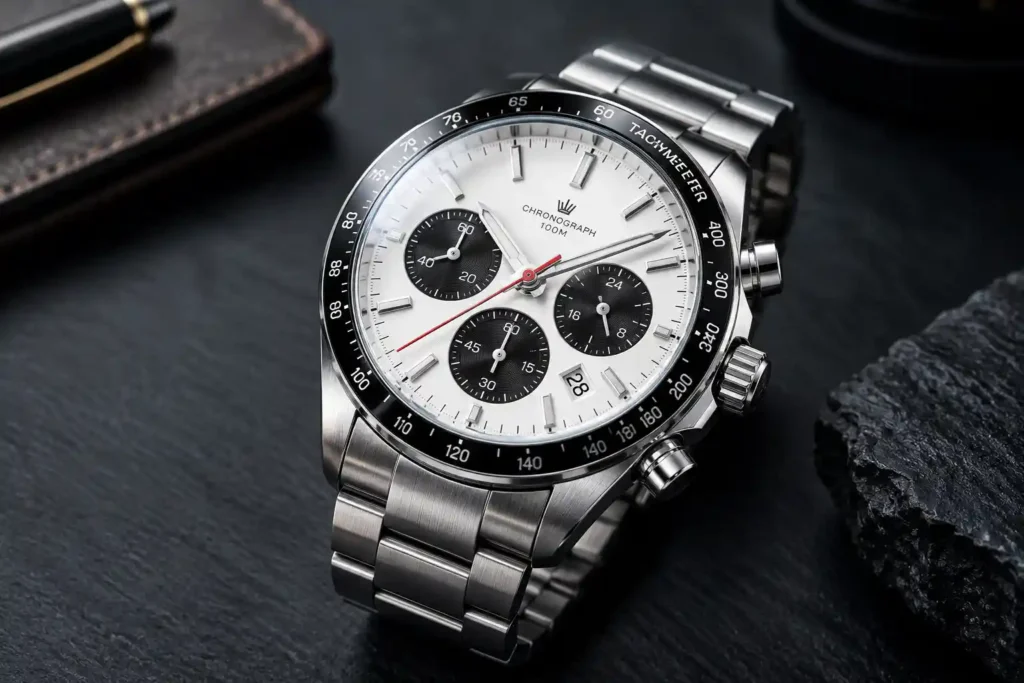
A chronograph is a watch with a stopwatch built into the movement. According to Hamilton’s watch guide, the mechanism measures elapsed time without interrupting the normal time display.
The key idea is “without interrupting.” Your watch keeps telling the time while the stopwatch runs on its own.
The name comes from two Greek words, chronos for time and graphein for to write. Worn & Wound traces that origin to the earliest versions, which literally marked a dial with ink.
Modern versions skip the ink. Thankfully, because nobody wants a stained shirt cuff.
A regular three-hand watch shows the time and nothing else. A chronograph adds a second job, and that job is measuring short stretches of time on demand.
The Parts That Make a Chronograph Look Different
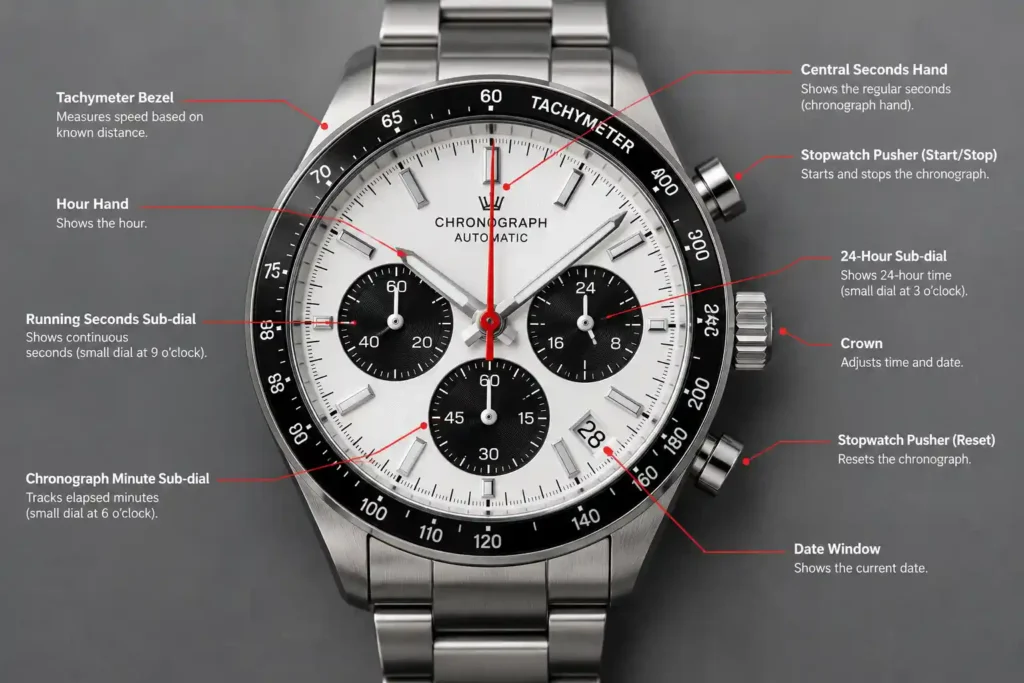
A chronograph has a few features that a basic watch lacks. Once you know them, the dial stops looking like a puzzle.
The Pushers
Most chronographs have two pushers, one above the crown and one below. Hamilton explains that you start, stop and reset the stopwatch with them.
Hourstriker describes the standard layout in more detail. The pusher at 2 o’clock starts and stops the timing, and the one at 4 o’clock resets it.
Some watches use a single pusher for all three jobs. Collectors call that design a monopusher.
The Central Chronograph Seconds Hand
This hand sweeps around the dial while the stopwatch runs. It stays separate from the hand that shows the regular running seconds.
Think of it as a second opinion that only speaks when you ask.
The Sub-Dials
The small dials track longer spans. Depending on the layout, they count elapsed minutes and sometimes hours.
Some also show running seconds or the date. Layouts vary by brand, so read the markings on your own dial before you press anything.
The Tachymeter and Other Scales
Many chronographs print a scale on the bezel or the edge of the dial. That scale turns the stopwatch reading into something useful, like speed.
We cover the scales in their own sections below.
How Does a Chronograph Work?
Inside, a chronograph adds extra levers and wheels to the normal timekeeping train. A clutch connects the stopwatch to the movement when you press start and disconnects it when you press stop.
Hourstriker explains that the first press couples the chronograph mechanism to the going train. The second press releases it so you can read the result.
Barrington Watch Winders describes the stopwatch gears as running independently of the main ones. That separation is why timing an event does not disturb the time of day.
Using one takes three simple steps:
- Press the top pusher to start timing.
- Press it again to stop and read the result.
- Press the lower pusher to reset the hands to zero.
On a standard design, the reset pusher stays blocked while the chronograph runs. You must stop it first, which protects the mechanism from careless pressing.
Mechanical Versus Quartz
Chronographs come in mechanical and quartz versions. A quartz chronograph runs on a battery and electronics, while a mechanical one runs on springs and gears.
Quartz models are usually simpler to maintain. Mechanical models appeal to people who enjoy the craft.
Modular Versus Integrated Movements
Some automatic chronographs stack a chronograph module on a base movement. Others build the complication into the movement from the start.
Neither is automatically better. Integrated movements earn praise for design, while modular ones can suit simpler servicing.
Column Wheel Versus Cam: What Controls the Pushers
Mechanical chronographs use one of two systems to control start, stop and reset. They are the column wheel and the cam.
A column wheel looks like a tiny castle turret. Rotate Watches notes that brands such as Zenith and Rolex use it in well-known calibers.
A cam system replaces that turret with a shaped part that moves the levers. Hourstriker names the Valjoux 7750 as the famous example.
Worldtempus reports that the column wheel costs more to make and gives a smoother pusher feel. The cam is robust, cheaper and suited to high-volume production.
Does that make the cam worse? Not necessarily. Deployant points out that a cam chronograph runs essentially the same, because precision depends on the balance rather than the switching method.
So treat the column wheel as a nice feel rather than a guarantee of accuracy. If you can, press the pushers in a shop before you decide.
What Is a Flyback Chronograph?
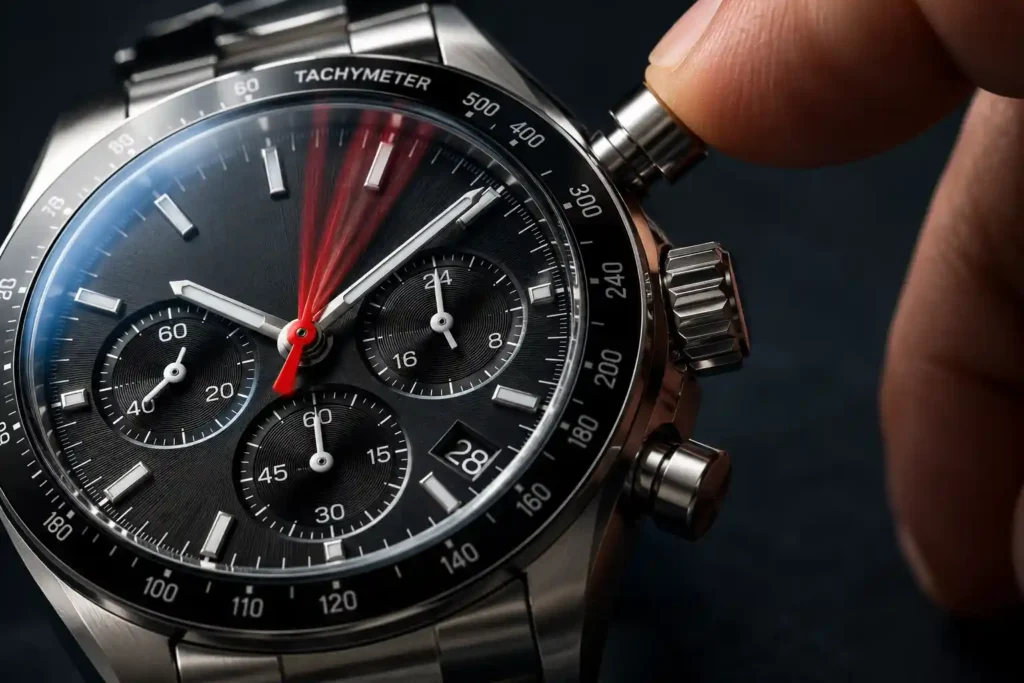
On a standard chronograph, timing a second event takes three presses: stop, reset and start. A flyback chronograph shortens that to one.
Hourstriker explains that you press the reset pusher while the chronograph is still running. The hands snap to zero and start again instantly.
That helps with repeated laps or back-to-back intervals. Worn & Wound reports that Longines created the first flyback caliber in 1936.
A Short History of the Chronograph
The chronograph has a better backstory than most gadgets.
Louis Moinet and the 1816 Breakthrough
Historians now credit French watchmaker Louis Moinet with the first chronograph, built in 1816 to track astronomical objects. Wikipedia’s chronograph entry notes that his compteur de tierces beat at 216,000 vibrations per hour.
His piece resurfaced in 2013. Before that, most sources gave the credit to someone else.
Nicolas Rieussec and the Horse Races
Nicolas Mathieu Rieussec developed the first commercially marketed chronograph in 1821. The story says King Louis XVIII loved horse racing and wanted to know exactly how long each race lasted.
Rieussec delivered a device that marked a rotating dial with ink. The Greek roots of the word fit that design perfectly.
Wrist Chronographs and Separate Pushers
Teddy Baldassarre’s history says Longines produced a wrist chronograph in 1913 with accuracy to one fifth of a second. Gaston Breitling later introduced a separate reset pusher.
Sources disagree on the year, with some citing 1915 and others 1923. That is common in watch history, where brands love a good origin story.
The 1969 Race
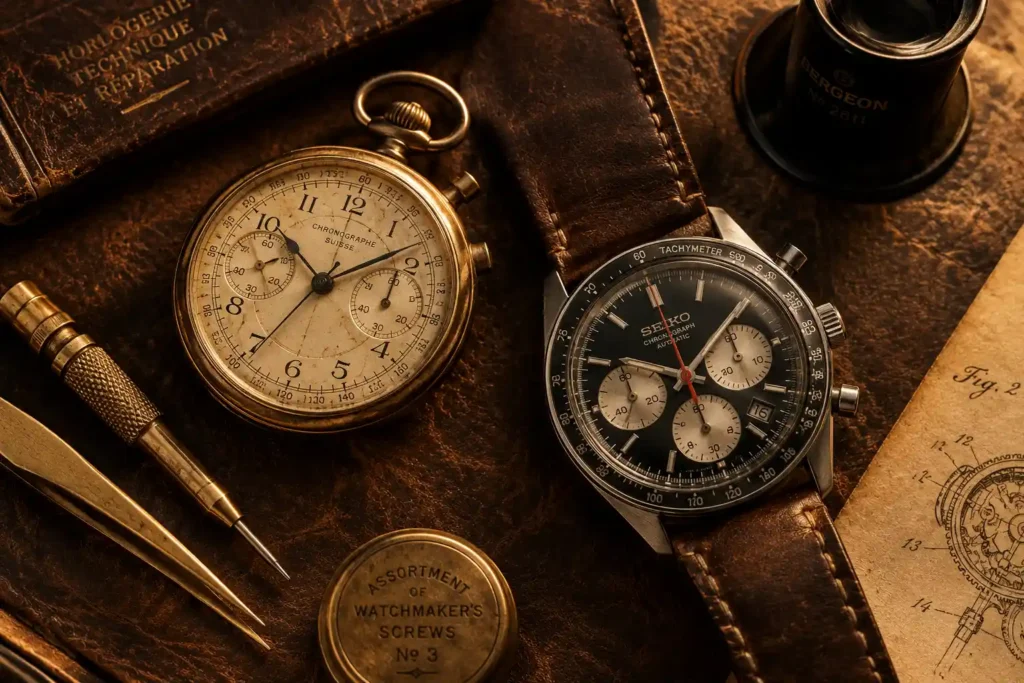
Then came 1969, when the industry raced to build the first automatic chronograph. Time and Watches reports that Zenith announced its El Primero in January, with a beat of 36,000 vibrations per hour.
Seiko launched its 6139 in Japan, and the Chronomatic group, which included Heuer, Breitling and Hamilton-Buren, released the Caliber 11. Which one counts as first depends on how you define the word.
Worn & Wound adds that the 6139 was the first automatic chronograph movement in outer space. It also notes the Valjoux 7750 arrived later, in 1974.
What Is a Chronograph Watch Used for?
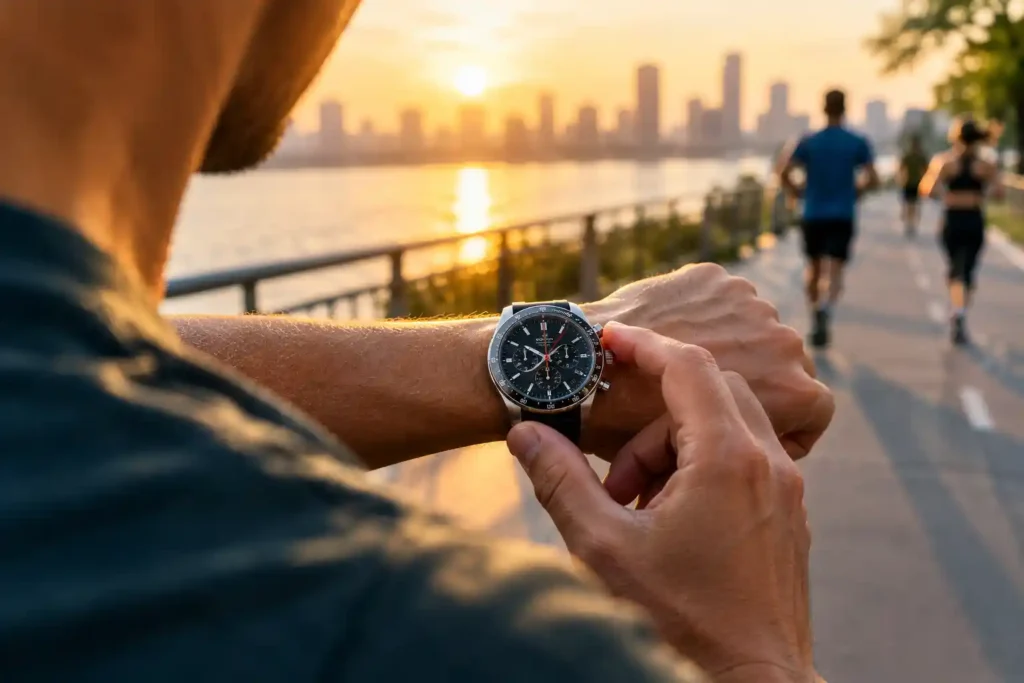
This is the question most readers care about. Does a stopwatch on your wrist matter when your phone has one?
Sometimes it does. Here are the practical uses.
Timing Everyday Tasks
You can time a boiling egg, a parking meter, a workout interval or a presentation. The watch already sits on your wrist, so there is no unlocking or app hunting.
It also stays silent. No alarm sounds, which your colleagues will appreciate.
Rating Repeated Tasks
A tachymeter can rate repeated events, not only speed. Time one full cycle of a task, then read the hourly rate from the scale.
One watch guide suggests production line cycles or even a barista pulling an espresso. It is a quirky use, but it works.
Sport and Lap Timing
Runners, swimmers and cyclists time intervals with a chronograph. A flyback model suits repeated efforts because it resets and restarts in one press.
Aviation and Motorsport
Barrington Watch Winders says the chronograph built its reputation from the racetrack to the cockpit. Brands noticed and designed dials around those customers.
That heritage explains why so many chronographs carry motorsport or aviation styling.
Space Missions
Omega’s Speedmaster is the best-known example. Gear Patrol reports that NASA flight-qualified the Speedmaster Professional in 1965.
The same article points out the irony of its tachymeter. The scale suits car speeds over one kilometer, which does little at orbital velocity.
Everyday Style
Many people buy a chronograph because it looks good. The sub-dials add depth, and the design works with a suit or a T-shirt.
That is a valid reason. Not every purchase needs a spreadsheet.
How to Read a Tachymeter Scale
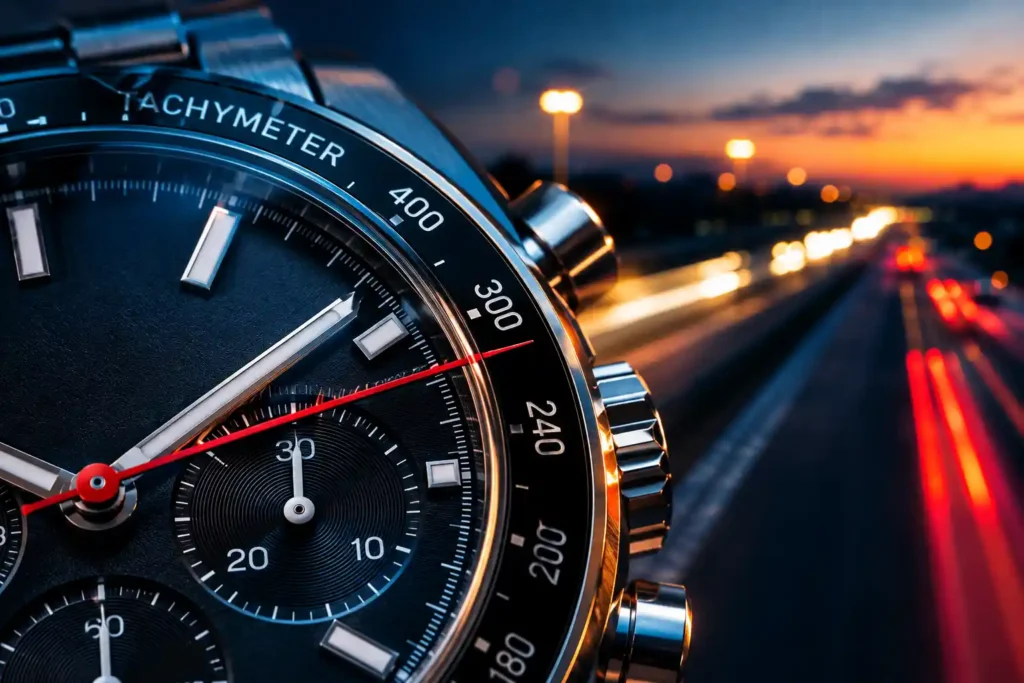
A tachymeter scale turns elapsed time over a known distance into average speed. Barrington Watch Winders explains that you start the chronograph at the first marker and stop it exactly one kilometer or one mile later.
The seconds hand then points to your average speed on the scale. The math behind it is simple: 3,600 divided by the seconds taken.
Two examples:
- 30 seconds over one kilometer reads 120 kilometers per hour.
- 45 seconds over one kilometer reads 80 kilometers per hour.
The distance must be exact. A late start or a wrong marker ruins the result.
The scale also has limits. A reading over one kilometer tops out at 60 seconds, so slower speeds fall off the scale.
You can even run it backward. If you know your speed, start the chronograph and stop it when the hand reaches that number to mark one unit of distance.
Telemeter and Pulsometer Scales
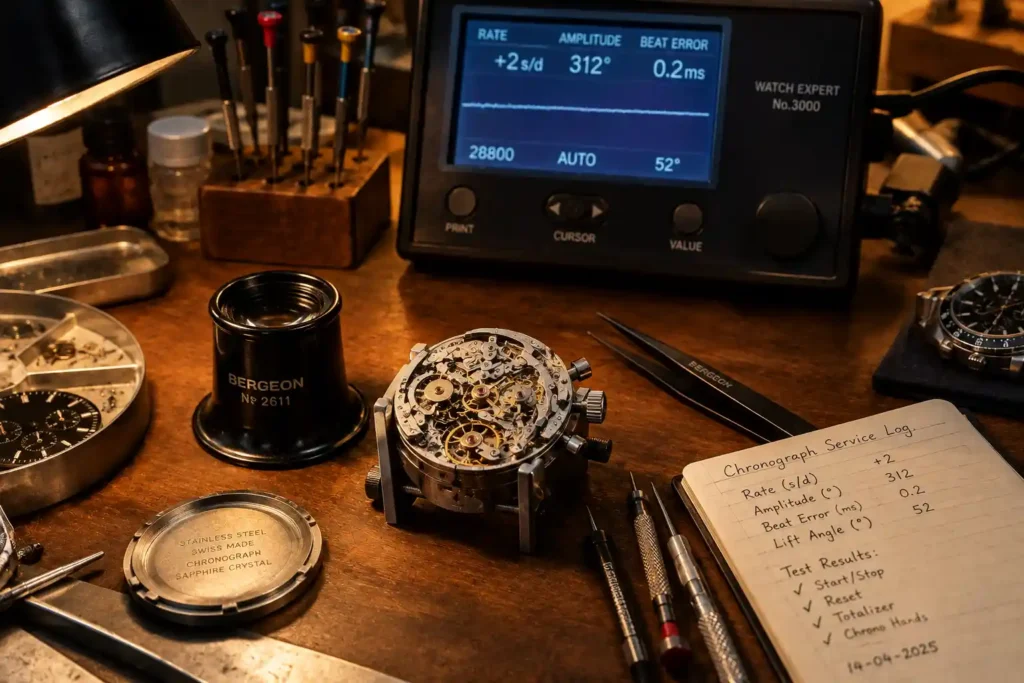
Some dials add two rarer scales. They look exotic, yet each solves a simple problem.
The Telemeter
A telemeter estimates how far away an event is, using the gap between light and sound. Start the chronograph when you see lightning and stop it when you hear thunder.
The scale then shows the approximate distance. Montres Passion notes that makers base the scale on a speed of sound around 333 or 340 meters per second.
Do the quick math. Three seconds at 340 meters per second gives roughly one kilometer.
The same source adds that artillerymen once used it to estimate the distance to enemy fire. Today, storm watching is the friendlier use.
The Pulsometer
A pulsometer measures heart rate, and doctors once relied on it. Cortina Watch calls it a doctor’s watch and says the scale usually counts 15 or 30 pulses.
You start the chronograph at a beat, count to the marked number and stop. The hand then shows beats per minute.
For a 30-pulse scale, the math is 1,800 divided by the seconds taken. If the hand stops at 30 seconds, the rate is 60 beats per minute.
Time and Tide notes that Omega’s Speedmaster Chronoscope carries tachymeter, telemeter and pulsometer scales together.
Chronograph Versus Chronometer
These two words look alike, and people mix them up constantly. They are not the same thing.
A chronograph measures elapsed time. A chronometer has passed an accuracy test.
The terms do not exclude each other. Teddy Baldassarre’s guide notes that a chronograph can also be a chronometer if it meets the standards.
What the Chronometer Test Involves
Swiss certification comes from COSC. The official site says a mechanical movement is tested for 15 days, in five positions, at three temperatures.
The movement must keep an average daily rate between minus 4 and plus 6 seconds. COSC tests the movement without its case, so the finished watch can behave a little differently.
Some brands run stricter tests of their own. WatchGecko reports that Rolex certifies its watches to minus 2 and plus 2 seconds per day.
Wikipedia also notes a debate among enthusiasts about how meaningful the COSC test is. Treat certification as one useful signal rather than the whole story.
Pros and Cons of Owning a Chronograph
Every complication has a trade-off. Here is the honest version.
The Good Parts
- You get a stopwatch without carrying anything extra.
- The dial looks more interesting than a standard layout.
- Many models carry real heritage and a clear purpose.
The Not-So-Good Parts
- The dial can look cluttered, which slows quick time reading.
- Mechanical chronographs usually cost more to service because the movement is more complex.
- Careless pusher use can wear parts over time.
None of these should scare you off. They simply set expectations.
How to Choose a Chronograph Watch
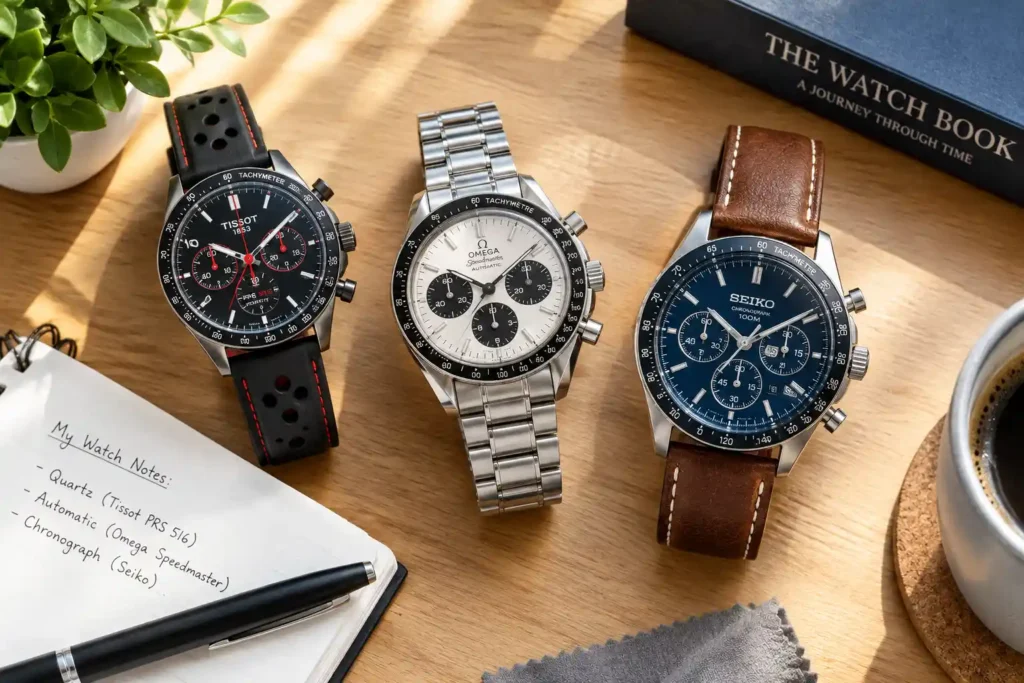
Start with what you will actually do with it. A casual wearer and a lap-timing enthusiast need different things.
Pick Your Movement
Choose quartz for convenience and lower upkeep. Choose mechanical or automatic if you value the mechanism itself.
Check the Dial Layout
Make sure the sub-dials read clearly at a glance. Contrast and spacing matter more than the brand name.
Test the Pushers
Press them in a shop if you can. A clean, confident feel suggests good adjustment, whether the watch uses a column wheel or a cam.
Decide on the Scale
A tachymeter is handy if you like the look or plan to use it. If you will never time a vehicle, a cleaner dial may suit you better.
Set a Realistic Budget
Chronographs range from affordable quartz models to high-end mechanical pieces. Set your range first, then compare movement, case size and service costs.
If you want to see how a major brand presents its watches, read our Rolex watch review. It shows how a leading maker describes design and function.
Simple Care Tips
A chronograph does not need fussy treatment, but a few habits help.
- Stop the stopwatch before you reset it.
- Check your manual before pressing pushers near water, since water resistance varies by model.
- Follow the manufacturer’s service schedule.
- Replace the battery on schedule if your watch runs on quartz.
Hourstriker notes that some watches use screw-down pushers for higher water resistance. In that case, unscrew the pushers before use.
Final Thoughts
A chronograph is a watch with a stopwatch that runs beside the clock. Pushers control it, sub-dials track the time, and optional scales turn seconds into speed, distance or heart rate.
It began in the early 1800s as a tool for astronomers and race fans. Today, it works as a practical timer and a stylish piece of everyday gear.
Whether you time laps, boil eggs or just like the look, a chronograph earns its place on the wrist. Pick one that fits your habits, and it will keep doing its job quietly.
FAQs (Because People Keep Asking)
1. What is a chronograph watch in simple terms?
It is a watch with a built-in stopwatch. You time events with the pushers while the regular time keeps running.
2. What is a chronograph watch used for in daily life?
People use it to time tasks, workouts, meetings and cooking. It also helps with lap timing and repeated intervals.
3. Is a chronograph the same as a chronometer?
No. A chronograph measures elapsed time, while a chronometer has passed an accuracy test. One watch can be both.
4. Who invented the chronograph?
Louis Moinet built the earliest known chronograph in 1816. Nicolas Rieussec developed the first commercially marketed one in 1821.
5. What does the tachymeter on a chronograph do?
It converts elapsed time over a known distance into average speed. You time one kilometer or mile, then read the scale.
6. What is a flyback chronograph?
It lets you reset and restart in a single press while the chronograph runs. That makes it handy for repeated timing.
7. Is a column wheel chronograph better than a cam one?
It usually feels smoother, but both types time accurately. Precision depends mainly on the balance and the overall movement quality.
8. Can I press the reset pusher while the chronograph runs?
On a standard design, no. Stop the chronograph first, then reset it.
9. Do I need a chronograph watch?
No, but you may enjoy one. If you like the look and the stopwatch function, it is a fun addition.
10. Are chronographs hard to use?
Not at all. Start, stop and reset take three presses, and you can learn them in a minute.